

Quick Summary
Enforcement patterns custody NC can significantly affect how judges evaluate parental credibility. Even if recent compliance improves, courts often examine long-term behavior and consistency when determining what arrangement best supports the child’s stability and welfare.
When custody enforcement issues repeat over time, courts may focus more on long-term patterns than recent improvements. In North Carolina custody disputes, judges often evaluate whether a parent has consistently followed court orders when determining what arrangement best serves the child’s stability.
Even when a parent begins complying with custody orders shortly before a hearing, courts still examine whether that change reflects genuine accountability or temporary adjustment. North Carolina Divorce Attorneys at Martine Law often explain that enforcement history, credibility, and the child’s routine all influence how courts interpret recent improvements. Understanding how these enforcement patterns are evaluated can help you realistically assess how your case may be viewed during custody proceedings.
How Courts Evaluate Enforcement History
Courts evaluate enforcement history by examining patterns of behavior over time. Judges look beyond isolated incidents and focus on consistency, reliability, and respect for court orders.
When analyzing enforcement patterns custody NC, courts commonly review:
- The frequency and duration of past violations
- Whether exchanges or visitation were repeatedly disrupted
- Prior contempt findings or enforcement actions
- The impact of those violations on the child’s stability
If violations occurred frequently, the court may view them as a pattern rather than isolated mistakes. Issues involving custody order enforcement are often addressed through civil contempt proceedings, which may arise when court orders are repeatedly ignored. You can learn more about how these cases are handled in civil contempt custody enforcement NC.
Courts also consider whether custody decisions support the best interests of the child, which is the central standard in North Carolina custody law. The statute outlining this framework can be reviewed. Even when compliance improves later, courts typically evaluate whether the change appears sustained and reliable.
Why Recent Compliance May Be Scrutinized
Recent compliance is considered by courts, but it is rarely evaluated in isolation. Judges assess whether improved behavior represents genuine accountability or a temporary adjustment made close to litigation.
Timing often plays a role in this evaluation. If compliance improves only after repeated violations or immediately before a hearing, courts may question whether the change reflects a long-term shift in parenting behavior. Judges often look for documentation, communication records, and consistent adherence to court orders when evaluating credibility.
Speaking with a family law attorney can help you assess how this evaluation may apply to your case.
For example, selective compliance can sometimes raise concerns if certain parts of a custody order are followed while others are ignored. Courts may review these situations closely when determining credibility and long-term reliability. You can explore how courts interpret these situations in selective compliance custody NC.
Potential Consequences of Established Patterns
When courts identify a consistent enforcement pattern, those findings can influence future custody decisions. Judges prioritize stability and predictability for children when evaluating parenting arrangements.
Possible outcomes of repeated enforcement issues include:
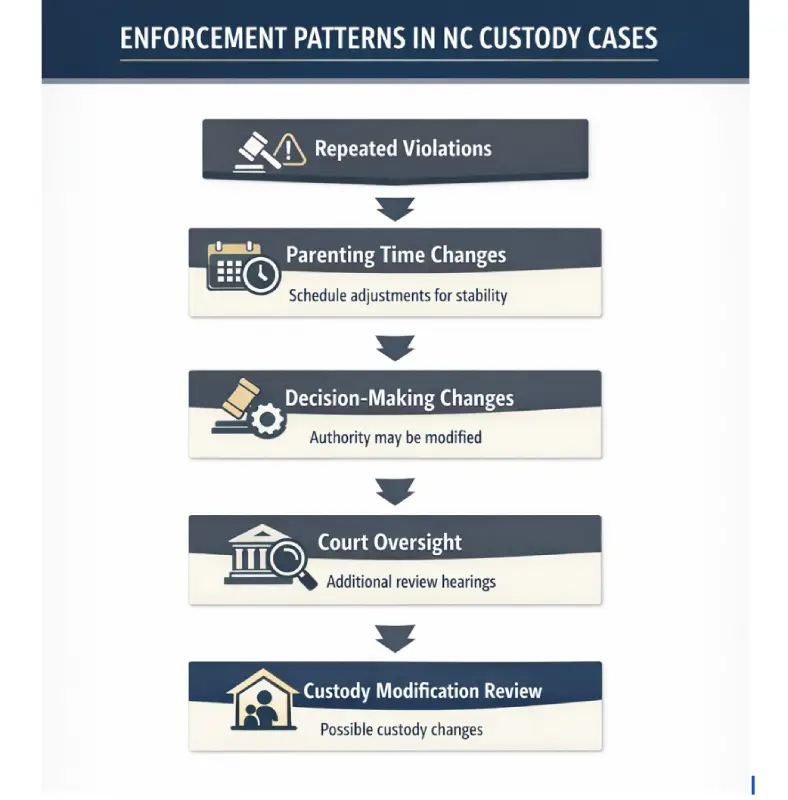
In more serious situations, repeated violations may influence how a judge interprets a parent’s credibility and willingness to cooperate with the court’s expectations. Courts may also consider whether a substantial change in circumstances exists if enforcement conflicts significantly affect the child’s environment.
Additional guidance about custody modifications can be found in modified custody Substantial Change of Circumstances: Using Chronic Non-Compliance to Modify NC Custody
Demonstrating Meaningful and Sustained Change
If past enforcement issues exist, demonstrating sustained improvement can help courts reassess the situation. Judges often look for measurable actions rather than verbal assurances.
Parents may demonstrate improvement by maintaining reliable exchanges, following court schedules consistently, and documenting communication with the other parent. Maintaining detailed records of compliance can help clarify whether behavioral changes are genuine and consistent.
Over time, a documented pattern of stability may gradually outweigh earlier enforcement concerns. Courts generally respond more positively when improvements are maintained consistently rather than appearing only during active litigation.
When Enforcement Patterns Shape Custody Outcomes
Enforcement history often plays an important role in how courts evaluate parental reliability and the child’s best interests. While recent improvements can help clarify a parent’s commitment to following court orders, judges usually assess whether those changes reflect a long-term behavioral shift.
Because enforcement patterns custody NC can influence credibility, parenting schedules, and court oversight, it is important to carefully evaluate your compliance history and available documentation. Understanding how courts interpret these patterns may help you prepare for custody proceedings and anticipate possible outcomes.
If you need guidance about how enforcement history may affect your custody situation, you may contact North Carolina Divorce Attorneys at Martine Law at +1(704)2556992 to discuss your case and better understand your available legal options.
How Do Courts Balance Enforcement Records With the Child’s Best Interests?
Even when enforcement issues exist, courts must prioritize the child’s welfare. Judges evaluate current parenting ability, stability, and whether corrective actions have been taken. A parent’s past violations do not automatically determine future custody arrangements.
Enforcement history may influence credibility, but courts consider whether compliance has improved and whether the child’s needs are currently being met. Demonstrated responsibility over time can reduce the impact of earlier violations.
Ultimately, the court’s focus remains on safety, stability, and consistency rather than punishment for procedural mistakes.
What Should Parents Know Moving Forward?
Enforcement history can shape how courts evaluate credibility, especially in cases involving unfit parent custody NC allegations. Repeated violations may overshadow best-interest arguments when they reflect instability or disregard for court orders. However, not all enforcement issues indicate parental risk. North Carolina courts distinguish between procedural noncompliance and genuine harm.
Parents should understand how enforcement history custody NC records influence perception and prepare accordingly. Documented improvement, consistent compliance, and stability matter in judicial analysis. If you have questions about how prior enforcement issues may affect your custody case, you may call +1(704)-255-6992 or visit our Contact Us page to speak with North Carolina Divorce Attorneys at Martine Law for guidance tailored to your situation.
FAQs
Can recent compliance outweigh past violations?
Recent compliance can help, but it rarely erases a long record of violations immediately. Courts evaluate enforcement patterns custody NC over time to determine credibility and reliability. Judges typically look for sustained behavioral changes rather than short-term improvements made shortly before a hearing. Demonstrating consistent cooperation and accountability over an extended period may gradually strengthen how the court evaluates your compliance.
How long must I comply before the court views it favorably?
There is no fixed timeframe for compliance to be viewed favorably. Judges assess consistency and stability rather than counting specific months. The longer your improved behavior continues without interruption, the more persuasive it becomes. Courts typically evaluate whether the change reflects genuine long-term responsibility instead of adjustments made only in response to ongoing litigation.
What if the other parent claims recent compliance ignored custody NC concerns?
If the other parent argues that recent compliance ignored custody NC concerns, the court will review objective evidence. Documentation of parenting exchanges, communication records, and proof of adherence to court orders can help clarify the situation. Judges often compare recent conduct with prior enforcement history to determine whether the change reflects a meaningful improvement or temporary compliance.
Can repeated contempt findings affect custody decisions?
Yes, repeated contempt findings can affect custody decisions because they may influence how a judge evaluates reliability and respect for court authority. Ongoing violations can suggest difficulty following structured parenting arrangements. Courts sometimes examine the broader enforcement history when deciding whether custody orders require modification or additional oversight. For further context, you can review how courts address missed visitation proof NC contempt hearing..
