

Quick Summary
When you request a custody change in North Carolina, the court may review your past compliance with parenting orders before deciding whether your request should move forward. The timing custody modification motion courts evaluate often depends on enforcement records, previous disputes, and whether your actions show stability or ongoing conflict. A consistent enforcement record can influence how judges assess credibility and whether a modification request is appropriate.
In North Carolina custody disputes, the timing custody modification motion in NC courts evaluate can influence whether a judge considers the request seriously or views it as premature. Judges often review enforcement records, prior compliance with custody orders, and patterns of disputes between parents before deciding whether a modification request should move forward. These factors help courts determine whether the motion reflects a genuine change in circumstances or an unresolved conflict between parents.
Custody orders are designed to provide stability for children. When modification requests appear closely tied to enforcement disputes, courts may question whether the timing of the request is appropriate. Enforcement records can reveal patterns of missed exchanges, repeated violations, or ongoing conflict that influence how judges evaluate credibility and parental reliability.
North Carolina Divorce Attorneys at Martine Law assist individuals by explaining custody orders, enforcement procedures, and the legal standards courts apply when reviewing modification requests. Understanding how enforcement history influences timing decisions can help you approach custody modifications with clearer expectations.
Why Does Timing Matter in Custody Modification Motions in North Carolina?
Timing matters because courts expect custody modification requests to be based on a substantial change in circumstances rather than short-term conflict. When a parent files a modification motion soon after enforcement disputes, judges may question whether the request reflects a lasting issue affecting the child or simply an escalation of disagreements between parents.
North Carolina courts aim to protect stability in custody arrangements. Frequent attempts to modify orders can create uncertainty for children and increase litigation between parents. For this reason, judges often evaluate the context surrounding the motion, including how recently the last custody order was entered and whether enforcement issues remain unresolved.
Many custody disputes also intersect with other financial matters such as child support obligations, which may be addressed separately in family law proceedings. You can review how courts handle financial parenting responsibilities through this service page on child support cases in North Carolina.
The timing of a request may also affect credibility. If a parent consistently follows court orders and files a motion after documented concerns arise, courts may view the request differently than when the motion follows repeated enforcement disputes without clear evidence of a substantial change.
How Does Enforcement History Influence Custody Modification Decisions?
Enforcement records often provide judges with insight into how parents manage court orders over time. In many cases, enforcement history modification NC disputes show whether a parent has consistently complied with custody schedules or repeatedly failed to follow court directives.
Courts may review enforcement history to determine:
Enforcement Record Factor | Why Courts Review It |
Compliance with custody orders | Shows reliability and respect for court rulings |
Consistent parenting exchanges | Demonstrates stability for the child |
Repeated contempt filings | May indicate ongoing conflict |
Escalating disputes | Raises concern about parenting cooperation |
A consistent record of compliance may support a parent’s credibility when requesting a modification. However, a history of repeated enforcement issues may raise concerns about whether a modification request will improve stability or simply extend existing conflict.
Many enforcement disputes are closely connected to contempt proceedings. For a deeper explanation of how courts enforce custody orders, see this related article:
Know More – Civil Contempt and Custody Enforcement in NC
For general legal guidance about custody law, the North Carolina Judicial Branch provides an overview of custody standards.
What Enforcement Patterns Can Delay a Modification Request?
Some enforcement patterns can cause courts to delay or closely scrutinize modification requests. Judges often prefer to resolve enforcement disputes first before considering whether a custody change is necessary.
When reviewing enforcement history modification NC disputes, courts may examine whether repeated violations reflect temporary disagreements or deeper concerns affecting the child’s well-being. If enforcement proceedings remain unresolved, judges may determine that a modification motion is premature.
Certain patterns may raise questions about the timing of a modification request. For example, when enforcement filings occur frequently within a short time period, courts may conclude that parents are still attempting to resolve compliance issues within the current order.
Property disputes between parents can also influence litigation dynamics in family law cases. These financial disagreements are addressed separately through the property division process in North Carolina divorces
When Can Enforcement History Support a Custody Modification?
Although enforcement disputes can sometimes delay modification requests, they may also demonstrate when a custody order is no longer functioning effectively. Courts may consider modification more seriously when enforcement records show persistent problems affecting parenting arrangements.
Repeated violations of court orders may indicate that the existing custody structure is not working. For example, when one parent repeatedly fails to follow schedules or consistently disrupts parenting exchanges, enforcement records may show that the order does not provide sufficient stability.
In these situations, enforcement history modification NC records may support arguments that a substantial change has occurred. Judges may evaluate whether modification could reduce ongoing disputes, improve compliance with parenting schedules, and provide a more stable environment for the child.
What Should Parents Consider Before Filing a Modification Motion?
Before filing a custody modification motion, it is often helpful to evaluate how enforcement history and timing may influence the court’s review. Courts typically expect parents to show that circumstances have changed in a way that directly affects the child’s welfare.
Parents often review documentation such as communication records, parenting schedules, and prior enforcement filings before deciding whether a modification request is appropriate. Courts rely heavily on documented patterns rather than isolated incidents when evaluating these requests.
If you want to discuss how enforcement records and timing may affect your situation, you may speak with a family law attorney to review how courts evaluate custody modification motions.
How Do Judges Evaluate Timing and Enforcement Together?
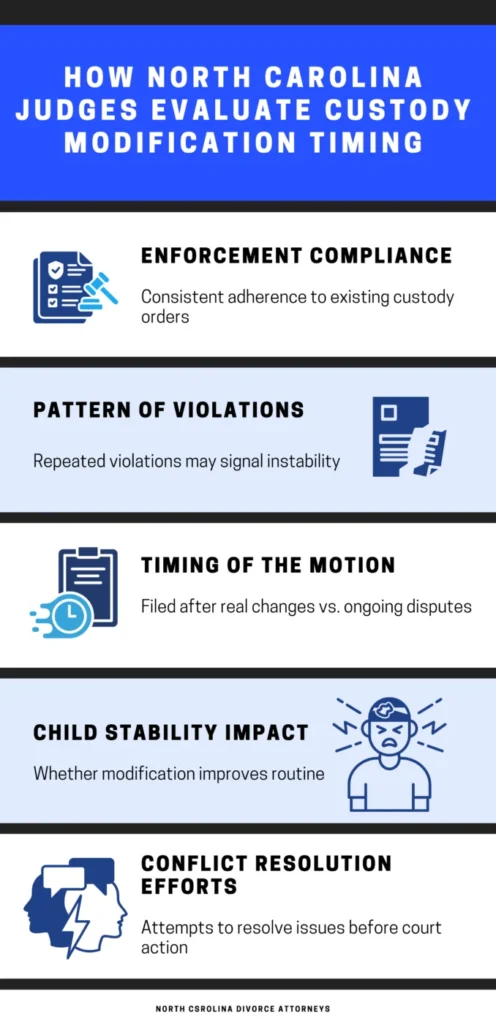
Judges often evaluate timing and enforcement history together when deciding whether to review a custody modification request. Courts are concerned primarily with stability for the child and whether the proposed modification will improve long-term parenting arrangements.
When reviewing modification requests, judges may consider whether enforcement disputes demonstrate ongoing instability or whether they reflect circumstances that justify a change in the custody order. Courts may also examine whether parents attempted to resolve disputes through communication and compliance before seeking court intervention.
These evaluations help judges determine whether a modification request reflects a meaningful change in circumstances or whether enforcement remedies under the existing order remain appropriate.
Source: North Carolina General Statutes
How Enforcement History and Timing Shape Custody Modification Decisions in NC
Custody modification decisions in North Carolina depend on more than a parent’s current concerns. Courts often review enforcement history, prior compliance with custody orders, and the timing of the motion before determining whether a change should be considered. Enforcement records can reveal patterns of cooperation or conflict that influence how judges evaluate credibility and stability.
When modification requests follow documented concerns that developed over time, courts may view them as more closely aligned with the child’s best interests. However, when enforcement disputes remain unresolved, judges may delay reviewing modification motions until compliance issues are addressed.
If you want to explore how enforcement history and timing may influence your custody situation, North Carolina Divorce Attorneys at Martine Law can help explain the legal considerations involved. You may call +1(704)-255-6992 or visit the Contact Us to learn how custody modification requests are evaluated in North Carolina courts.
FAQs
Can enforcement history affect custody modification decisions in North Carolina?
Yes, Courts often review enforcement records when evaluating modification requests because they reveal how parents have complied with existing custody orders. Judges may consider whether repeated violations or disputes demonstrate instability affecting the child. Enforcement records may also influence credibility when a parent requests changes. Courts rely on documented patterns rather than isolated incidents when determining whether a modification request should proceed.
Is there a waiting period before filing a custody modification in North Carolina?
No, North Carolina law does not impose a strict waiting period before filing a modification motion. However, courts require proof of a substantial change in circumstances affecting the child. If the motion is filed too soon after a custody order or enforcement dispute, judges may view the request as premature and require stronger evidence before reviewing the proposed modification.
Can repeated custody violations support a modification request?
Yes, When violations occur repeatedly, enforcement records may show that the current custody order is not functioning effectively. Courts may review whether the violations affect the child’s stability or parenting time. In some situations, consistent violations documented through enforcement proceedings may support arguments that a change in custody arrangements is necessary.
Does timing affect how courts review modification requests?
No, Missing visitation does not automatically mean a parent is unfit in North Carolina custody cases. Courts look at the reasons for the missed visits and the extent of disruption to the child’s routine. Occasional scheduling conflicts or unavoidable circumstances are treated differently from repeated interference. Judges focus on whether the behavior harms the child’s emotional stability, daily schedule, education, or overall well-being.
Should you speak with a family law attorney before filing a custody modification motion?
Yes. Legal guidance is essential to evaluate if enforcement history and timing meet the legal standards for a modification request. A lawyer can review your custody orders and enforcement records to determine if the circumstances support a change. Contact the North Carolina Divorce Attorneys at Martine Law for guidance at +1(704)-255-6992.
