
Quick Summary
When you request a custody change in North Carolina, your history of following court orders can influence the outcome. Courts review past compliance, missed parenting time, and enforcement actions before approving changes. Because judges weigh enforcement records NC when evaluating custody cases, your documentation, communication patterns, and consistency with existing orders may affect whether a custody modification moves forward.
When parents ask the court to modify an existing custody order, North Carolina judges review more than current parenting arrangements. Courts often examine prior compliance with custody orders, including enforcement filings, missed parenting exchanges, and past disputes between parents. In many cases, judges weigh enforcement records NC to determine whether a parent has consistently followed court directives and supported the child’s stability.
Enforcement history matters because it helps the court understand long-term parenting behavior rather than isolated events. Patterns of cooperation, repeated violations, or unresolved conflicts may influence how the judge evaluates whether a change in custody would benefit the child.
North Carolina Divorce Attorneys at Martine Law assist parents by explaining how enforcement history and custody modification factors NC may affect requests to modify custody orders. Understanding how courts interpret past enforcement actions can help you prepare stronger documentation and avoid common mistakes during the modification process.
What Do Judges Review When Considering Custody Enforcement History?
North Carolina judges examine enforcement history to evaluate reliability, credibility, and parental cooperation. The court reviews whether each parent has followed prior custody orders and how past disputes were handled. These records help the court determine whether the current custody arrangement still supports the child’s well-being.
Judges commonly review:
- Missed or denied parenting time exchanges
- Contempt findings related to custody violations
- Prior enforcement motions filed by either parent
- Communication patterns between parents regarding schedules
- Documentation showing attempts to resolve disputes
Courts focus on patterns rather than isolated events. A single scheduling conflict rarely determines the outcome, but repeated enforcement issues may raise concerns about whether the existing custody structure continues to serve the child’s best interests.
In situations where violations involve ongoing disputes over parenting schedules, courts may also review how custody orders are enforced and structured. Parents facing these issues often seek guidance about how custody orders and enforcement disputes are handled under North Carolina law.
How Do Judges Weigh Enforcement Records NC Courts Examine?
When judges weigh enforcement records NC courts examine how each parent responded to past custody conflicts and whether the behavior shows long-term cooperation or instability. Enforcement records provide context for evaluating parental credibility and decision-making.
Judges often look at whether violations were intentional or caused by unavoidable circumstances. For example, the court may consider whether a missed parenting exchange resulted from an emergency or from repeated disregard of the court order.
Another key consideration is whether the parent made efforts to correct the issue. Courts generally view proactive communication and problem-solving more favorably than repeated escalation through enforcement filings. By reviewing enforcement patterns over time, judges can better determine which custody arrangement supports stability for the child.
For reference on custody law and procedures, the North Carolina Judicial Branch provides guidance on child custody rules and court processes.
What Custody Modification Factors NC Courts Evaluate Alongside Enforcement Records?
Although enforcement history can influence the court’s view of a case, it is only one part of the broader legal analysis. Judges must also determine whether a substantial change in circumstances has occurred before modifying custody.
Several custody modification factors NC courts evaluate include the child’s stability, the parenting environment, and each parent’s ability to follow court orders consistently. These factors help the court determine whether changing custody would improve the child’s overall well-being.
The court may also review whether safety concerns exist that could require urgent court intervention. In those situations, parents sometimes explore options related to emergency custody proceedings when a child’s welfare may be at risk.
The court may also review:
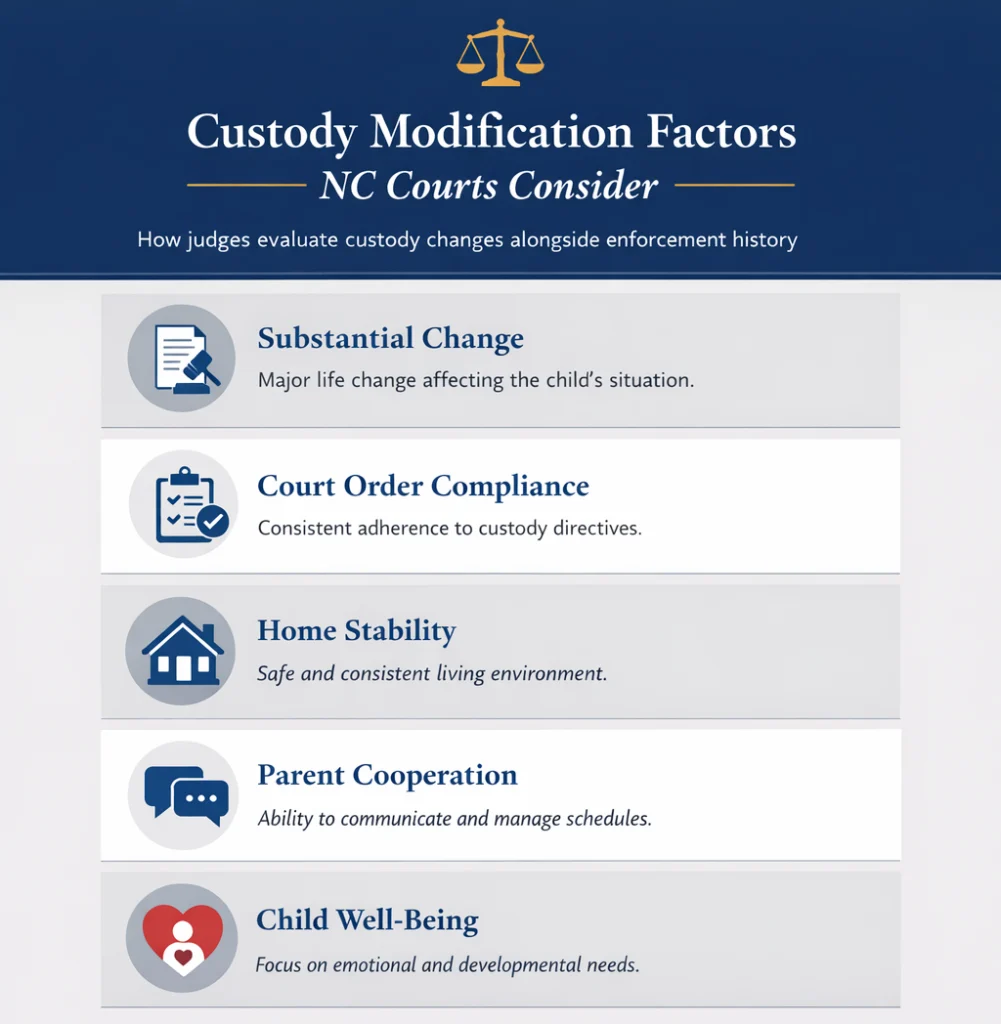
Source: § 50-13.7. Modification of order for child support or custody.
Enforcement history often helps judges interpret these factors. A pattern of missed parenting exchanges or repeated disputes may indicate ongoing instability, while consistent compliance may support a parent’s request for modification.
When Can Enforcement Records Support a Custody Modification Request?
In some situations, enforcement records may strengthen a request to modify custody. When documentation shows ongoing violations or consistent disruption to parenting schedules, the court may view the existing order as no longer functioning effectively.
For example, repeated denial of parenting time or frequent violations of exchange schedules can interfere with the child’s routine. When these problems continue despite court intervention, a judge may consider whether a modified custody structure could provide greater stability.
Courts often rely on documented evidence such as communication records, parenting logs, and prior enforcement filings to evaluate these concerns. Well-organized records allow the court to see how disputes developed over time and whether the issues remain ongoing.
If you want to discuss how enforcement history may affect your custody case, you may speak with a family law attorney to review how these factors may apply to your situation.
Parents may also review additional guidance on how courts respond to enforcement violations, including patterns of disputes discussed.
Know More – Civil Contempt in Custody Enforcement NC.
How Can Documentation Influence a Judge’s Decision?
Documentation often plays a central role when courts review enforcement history. Judges rely on written evidence to determine what actually occurred during parenting exchanges and scheduling conflicts.
Clear records help establish whether violations were occasional misunderstandings or part of a continuing pattern. Courts frequently review parenting calendars, written communications between parents, and copies of enforcement filings when evaluating custody disputes.
Well-maintained documentation may also demonstrate efforts to resolve conflicts outside of court. When records show attempts to communicate, adjust schedules, or follow court directives, judges may view those efforts as evidence of cooperation.
Because enforcement disputes often involve conflicting claims from both parents, organized documentation helps the court make more accurate findings about past behavior.
How Enforcement History Can Affect Custody Modification Outcomes in NC
Custody modification decisions depend on whether the court believes a change will improve the child’s stability. Enforcement history provides insight into whether each parent has consistently supported the existing custody arrangement.
When judges evaluate these cases, they often look for long-term patterns rather than isolated incidents. A parent with repeated violations may face greater scrutiny when requesting custody changes. On the other hand, a parent who consistently follows court orders may have stronger credibility during modification proceedings.
Understanding how enforcement history interacts with custody modification factors NC courts consider can help parents approach these cases with better preparation and realistic expectations.
What This Means When Judges Weigh Enforcement Records NC
When parents seek to modify custody orders in North Carolina, enforcement history can influence how the court evaluates the case. Judges often review patterns of compliance, communication, and dispute resolution to determine whether the current arrangement continues to support the child’s stability.
Enforcement records provide insight into long-term behavior rather than isolated conflicts. Missed parenting exchanges, repeated enforcement filings, or documented cooperation between parents can all shape how the court views the situation. These records also help judges interpret custody modification factors NC courts consider when deciding whether a substantial change in circumstances has occurred.
North Carolina Divorce Attorneys at Martine Law help parents review enforcement history and custody documentation before pursuing custody modification. If you would like to discuss how these issues may apply to your case, you may call +1(704)-255-6992 or visit the Contact Us page to speak with a family law attorney.
FAQs
Do enforcement records affect custody modification decisions in North Carolina?
Yes. Courts often review past compliance with custody orders when deciding whether a modification is appropriate. When judges weigh enforcement records NC courts examine prior violations, missed parenting exchanges, and enforcement filings. These records help judges evaluate credibility, cooperation, and whether the existing custody order continues to support the child’s stability.
Can repeated custody violations influence a judge’s decision?
Yes. Repeated custody violations may affect how the court evaluates parental reliability. When violations occur frequently or continue after enforcement actions, judges may view the pattern as a sign that the current custody arrangement is not functioning effectively. Courts often review documentation and prior enforcement records to determine whether the behavior affects the child’s stability.
What evidence helps demonstrate enforcement issues in custody cases?
Yes. Evidence such as parenting calendars, written communication between parents, enforcement filings, and records of missed exchanges can help demonstrate enforcement issues. This concrete documentation is crucial for showing a history of non-compliance and poor co-parenting behaviors. Courts rely on documented evidence when reviewing disputes because it provides an objective record of events rather than relying solely on verbal testimony.
Do courts only rely on enforcement history when modifying custody?
No. Enforcement history is only one part of the court’s analysis. Judges must also review custody modification factors NC courts consider, including whether a substantial change in circumstances has occurred and whether the proposed modification would benefit the child’s welfare. Other essential factors, such as the relationship between the child and each parent, are also heavily weighed.
Should you speak with a lawyer before requesting custody modification?
Yes. Because custody modification cases involve legal standards and documentation requirements, many parents choose to review their situation with a family law attorney before filing. North Carolina Divorce Attorneys at Martine Law can explain how judges weigh enforcement records NC and how custody modification factors NC may affect your case. You may call +1(704)-255-6992 or visit the Contact Us page to discuss your situation.
For additional guidance about when courts allow custody changes, see Know More – Modify Custody Substantial Change Circumstances.
