

Quick Summary
When you request a custody change in North Carolina, your compliance history with court orders can affect how quickly the court reviews your case. A show cause docket custody in NC record may reveal repeated violations or ongoing disputes. Judges often evaluate these enforcement records to determine whether a custody modification request should move forward quickly or whether additional review is needed before adjusting the parenting arrangement.
Custody cases, enforcement disputes can directly affect how quickly a court reviews a request to modify custody. When a parent appears on a show cause docket custody NC, the court examines whether an existing custody order was followed or violated.
These proceedings create a documented enforcement history that judges may later consider when determining whether a custody modification request should move forward immediately or require additional review. Repeated violations may signal that the existing custody order is not functioning effectively, while unresolved disputes may require the court to gather more information before moving the case forward.
The timing of custody modifications matters because enforcement conflicts can affect stability for the child and the credibility of both parents. Judges often review past compliance patterns to determine whether circumstances justify revisiting an existing order. Enforcement records may therefore play an important role in shaping the modification timeline custody NC cases follow in family court.
North Carolina Divorce Attorneys at Martine Law assist parents in evaluating enforcement history and understanding how compliance records may influence custody modification proceedings.
What Is a Show Cause Docket in North Carolina Custody Cases?
A show cause docket is used when the court believes a parent may have violated a custody order. The judge requires the parent to appear and explain why the order was not followed. These hearings create an official record of compliance issues, which can later influence custody disputes or modification requests.
During the hearing, the court evaluates whether the violation occurred and whether it was intentional or unavoidable. The judge may also determine whether contempt sanctions are appropriate. Because the proceeding becomes part of the official court record, it can shape how future custody issues are evaluated.
Parents dealing with enforcement disputes often review how existing custody orders work and what obligations each parent must follow under North Carolina law.
Courts frequently review several factors when determining whether enforcement action is necessary:
- Missed parenting time exchanges or schedule disruptions
- Failure to follow communication or co-parenting provisions
- Prior court findings related to contempt or enforcement
- Attempts by either parent to correct or resolve violations
Over time, this enforcement record can influence how the court views future custody disputes and may affect the modification timeline custody NC cases follow.
How Does Enforcement History Affect Custody Modification Timelines?
Enforcement history often becomes an important part of a custody modification review. When a parent requests a change to an existing custody order, the court typically examines past compliance with earlier rulings. A consistent pattern of violations can raise concerns about whether the current custody arrangement continues to serve the child’s best interests.
If enforcement records show repeated violations, the court may move more quickly to evaluate whether the custody order should change. Judges sometimes treat ongoing enforcement disputes as evidence that the existing arrangement is no longer functioning effectively. In those situations, scheduling a modification hearing sooner may help resolve ongoing conflicts affecting the child.
However, enforcement records can also slow the process. When parents present conflicting explanations about alleged violations, courts may need additional hearings or documentation before reviewing a modification request. Judges often examine whether the enforcement issues reflect temporary disputes or long-term patterns before adjusting custody arrangements.
North Carolina law governing child custody decisions and the child’s best interests can be reviewed in N.C. Gen. Stat. § 50-13.2:
When Can Enforcement Records Accelerate Custody Modification Decisions?
In some situations, enforcement records lead courts to evaluate custody changes sooner. When violations appear frequent or intentional, judges may conclude that the current custody order is not being followed effectively. If enforcement disputes repeatedly appear before the court, the judge may review whether the custody arrangement should be modified to better support stability for the child.
Cases involving serious parenting time disruptions may sometimes involve requests for emergency custody orders when immediate court intervention is necessary to address urgent concerns affecting the child.
Enforcement records therefore serve as an indicator of whether a custody arrangement continues to function properly. When violations are clearly documented, courts may move more efficiently toward reviewing whether a modification request should proceed.
Why Can Enforcement Conflicts Delay Custody Modification Requests?
While enforcement history sometimes accelerates custody reviews, it can also extend the timeline before a modification decision is made. Courts must carefully determine whether a modification request reflects a significant change affecting the child rather than a temporary dispute between parents.
Enforcement disputes frequently involve issues similar to those discussed in civil contempt custody enforcement cases in North Carolina, where courts examine whether a parent knowingly failed to comply with a court order.
Several circumstances commonly slow the process:
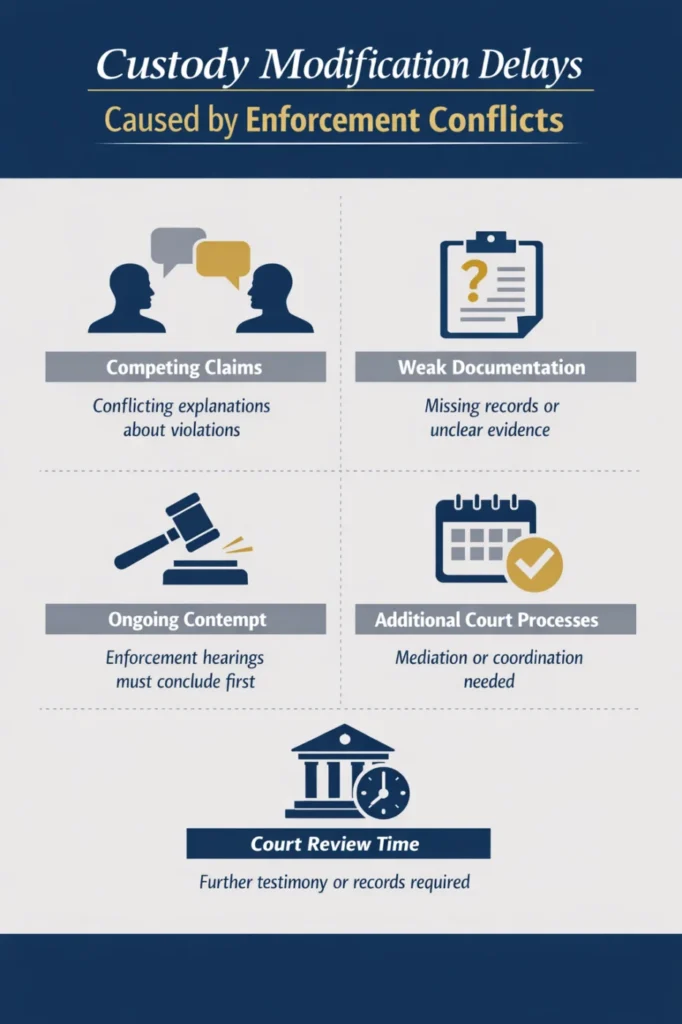
Source: Custody Modification Delays
When these issues arise, judges may require additional documentation or testimony before considering a custody change.
What Evidence Do Judges Review During Show Cause Hearings?
Judges reviewing enforcement disputes rely heavily on documentation. Written records often provide the clearest picture of whether a parent followed or violated the terms of a custody order. Courts generally look for consistent evidence showing how parenting schedules and communication requirements were handled over time.
Common forms of documentation include communication records, custody exchange logs, school schedules, and prior court filings. Judges may also examine whether a parent attempted to resolve conflicts before seeking enforcement through the court. Evidence demonstrating good-faith efforts to comply with court orders may influence how the judge evaluates each parent’s credibility.
Because enforcement proceedings often become part of the broader custody case record, organized documentation can help the court determine whether compliance issues represent isolated incidents or recurring problems that affect the modification timeline custody NC courts must evaluate.
How Can Legal Guidance Help Address Enforcement and Modification Issues?
Enforcement hearings and custody modification requests frequently overlap in family court. When a parent appears on a show cause docket, that proceeding may later influence how the court evaluates a request to modify custody. Reviewing enforcement history before filing a modification request can help parents understand whether their situation meets the legal standard for changing an existing order.
Parents sometimes seek guidance when determining whether enforcement disputes may affect future custody proceedings. Evaluating compliance records and documenting parenting schedules can clarify whether the issues raised in court represent isolated disagreements or ongoing problems affecting the child’s well-being..
If you want to discuss how enforcement history may influence your custody case, you may speak with the family law attorney to review your case.
How Enforcement Records Shape NC Custody Modification Outcomes
Enforcement proceedings often provide courts with important information about how well a custody order is functioning. Show cause hearings document whether parents comply with court orders, whether disputes repeatedly arise, and whether enforcement conflicts affect the child’s stability. Judges review this history when determining whether a custody modification request should move forward quickly or whether additional evaluation is necessary.
Because enforcement records become part of the broader custody case file, consistent documentation and a clear understanding of court procedures can help parents prepare for future hearings. Courts ultimately focus on whether custody arrangements promote stability and support the child’s well-being.
If you want to review how enforcement history may influence your custody case, North Carolina Divorce Attorneys at Martine Law can provide guidance. Call +1(704)-255-6992 or visit the Contact Us page for more information about your situation.
FAQs
Can a show cause hearing influence a custody modification request in North Carolina?
Yes. A show cause hearing creates a court record showing whether a parent complied with or violated a custody order. Judges may review this enforcement history when evaluating later custody modification requests. Repeated violations documented during enforcement proceedings may affect how the court evaluates stability, parental credibility, and whether the current custody arrangement continues to serve the child’s best interests.
Do custody violations automatically lead to custody modification in North Carolina?
No. Violating a custody order does not automatically result in a modification. Courts generally require proof of a substantial change in circumstances affecting the child’s welfare before altering custody arrangements. Enforcement proceedings may document violations, but judges still evaluate whether those violations demonstrate an ongoing issue that justifies modifying the custody order.
What does show cause docket custody NC mean in family court?
Yes. The term show cause docket custody NC refers to a court schedule used to review alleged violations of custody orders. During the hearing, the court asks the parent accused of violating the order to explain why the order was not followed. These proceedings create enforcement records that judges may later consider when evaluating custody disputes or modification requests.
What records help parents during enforcement or show cause hearings?
Yes. Courts often rely on written documentation when evaluating enforcement disputes. Records showing parenting schedules, communication between parents, and prior court filings can help clarify whether a violation occurred. Consistent documentation may help judges determine whether the issue represents a temporary conflict or an ongoing pattern affecting the custody arrangement.
Should parents speak with a lawyer before filing a custody modification request?
Yes. Reviewing enforcement history with a family law attorney can help determine if a custody modification is supported by documented changes. Parents considering changes may review how courts evaluate substantial change in circumstances for custody modification before filing. For guidance, contact North Carolina Divorce Attorneys at Martine Law at +1(704)-255-6992 or visit the Contact Us page to discuss how enforcement history may affect your case.
