

Quick Summary
Family money exchanged during a marriage can raise questions during divorce proceedings. Courts review whether financial support from relatives was a gift or a loan and how it fits into property division. Under marital vs separate property NC rules, the classification depends on intent, documentation, and how the funds were used during the marriage. These factors help determine how the transfer is treated in divorce litigation.
Informal transfers from family members often raise questions during divorce proceedings. When money or property is given without a formal agreement, courts must determine whether the transfer was intended as a gift or a loan.
This classification affects how assets are divided under marital vs separate property NC rules in divorce cases.
Courts evaluate factors such as intent, documentation, and how the funds were used during the marriage. Even transfers that occurred years earlier may influence property division.
North Carolina Divorce Attorneys at Martine Law regularly explain how courts review these financial situations within the state’s property division framework.
How Courts Distinguish Gifts From Family Loans
Courts distinguish between gifts and family loans by examining the intent behind the transfer. If the person providing the money expects repayment, courts may treat the transfer as a loan.
When repayment was not expected, the transfer may be considered a gift. Judges review the surrounding evidence to determine the purpose of the transfer.
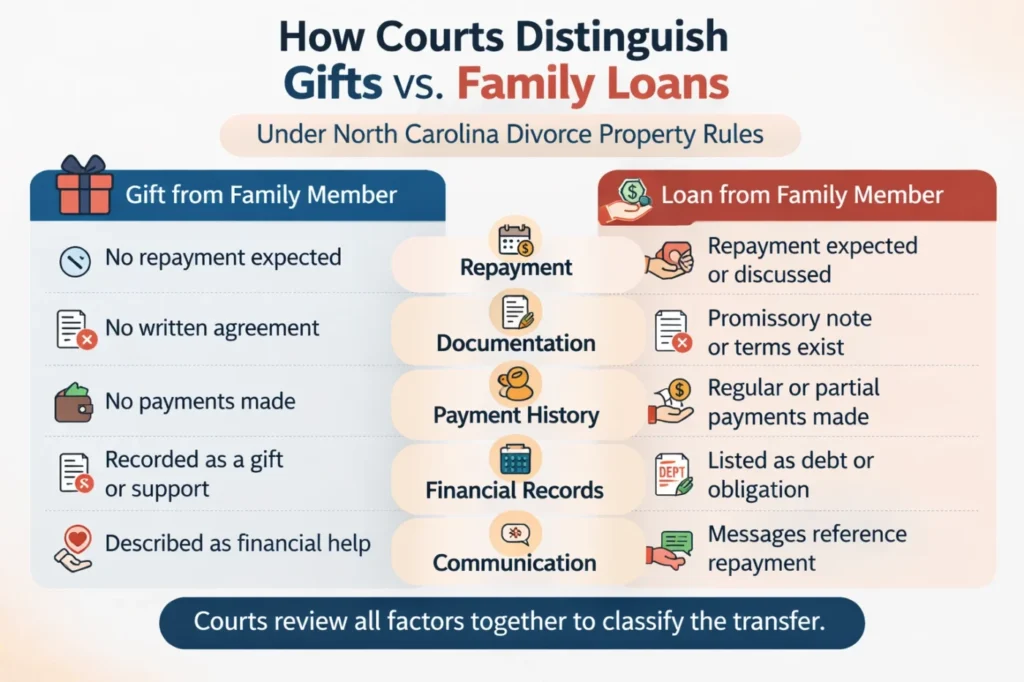
Because informal family arrangements often lack written contracts, courts rely on several indicators to understand how the transfer was intended and how it functioned during the marriage. Common factors courts review include:
- Whether a written agreement exists
- Whether repayment terms were discussed
- Whether payments were ever made after the transfer
- Whether financial records describe the transfer as a loan
Under North Carolina equitable distribution rules, these details help courts determine whether the transfer affects the marital estate and how it may be classified during property division.
Source: North Carolina General Assembly – Equitable Distribution
Courts review these indicators together rather than relying on a single factor. This overall evaluation helps determine whether a family transfer should be treated as a gift or a loan during property classification.
Role of Intent When Family Funds Are Given
Intent is one of the most important elements courts review when classifying family transfers. The person who provided the funds may explain whether repayment was expected or whether the transfer was meant as a gift.
Evidence used to determine intent may include:
- Statements made when the money was transferred
- Written messages or emails discussing repayment
- Testimony from the family member who provided the funds
- Financial records showing repayment attempts
These factors help courts determine how the transfer fits into marital vs separate property NC analysis. In some cases, related family law issues such as relocation guidance may also arise when financial support and parenting arrangements intersect during divorce proceedings.
How Documentation Influences The Property Classification Decisions
Documentation often plays a central role in determining whether a transfer was a gift or a loan. Courts rely on written records because informal family arrangements may otherwise lack clear proof.
Documents that may influence classification include:
- Promissory notes
- Bank transfer descriptions
- Emails discussing repayment
- Financial statements listing debts
When documentation is limited, courts may rely on testimony and financial behavior to determine the likely purpose of the transfer. Courts reviewing financial disputes during divorce apply broader family law principles that guide how evidence and property classification are evaluated.
When Family Gifts May Be Considered Separate Property
Certain gifts provided by family members may qualify as separate property under North Carolina law. Separate property generally includes assets given specifically to one spouse rather than to the marital partnership.
Courts examine whether the gift was directed to one individual or to the couple. Factors considered may include:
- Whether the gift was addressed to one spouse
- Whether the funds were deposited in an individual account
- Whether the transfer was described as a personal gift
These distinctions help courts determine whether an asset should remain separate or become part of the marital estate during property division. Understanding these distinctions helps explain how courts interpret marital vs separate property NC classifications during divorce proceedings.
Situations Where Family Loans Affect Marital Estate
Family loans can influence how debts and assets are evaluated in divorce. If a loan was used to purchase marital property or support household expenses, courts may consider how that obligation affects the overall financial picture.
Examples of situations courts review include:
- Loans used for a home purchase
- Funds used to support a family business
- Money covering household expenses during the marriage
Even when a loan came from a family member, courts may still treat the obligation as part of the marital financial structure.
Know More: Marital Debt: When Liability Allocation Becomes the Main Battle in an NC Divorce
Evidence Courts Use To Evaluate Informal Transfers
Courts rely on different types of evidence to determine whether money from a family member was intended as a gift or a loan. When documentation is limited, judges review financial records, testimony, and communication between the parties to interpret the purpose of the transfer.
These materials help courts evaluate how the transaction functioned during the marriage and how it should be classified under marital vs separate property NC rules. The table below summarizes common indicators courts consider when reviewing informal family transfers.
Court Review Factor | Indicator of a Gift | Indicator of a Loan |
Repayment expectation | No repayment expected by the donor | Repayment expected or discussed |
Written documentation | No written agreement or repayment terms | Promissory note or repayment terms exist |
Payment history | No payments made after the transfer | Regular or partial repayments made |
Financial records | Recorded as a personal gift or support | Listed as debt or obligation |
Communication between parties | Described as financial help or a gift | Messages referencing repayment |
Courts consider these factors together rather than relying on a single piece of evidence. The overall pattern of financial behavior and documentation helps determine how the transfer should be treated during divorce litigation.
Why Informal Family Transfers Are Creating Disputes
Informal transfers often lead to disputes because the expectations behind them may not be clearly recorded. Family members sometimes provide funds based on trust rather than formal agreements.
When divorce occurs, disagreements may arise about:
- Whether repayment was required
- Whether the funds belonged to one spouse
- Whether the transfer supported marital assets
These disputes require courts to interpret evidence and apply equitable distribution principles when determining property classification. In some situations, concerns related to fiduciary duties may also arise when questions about financial conduct and shared accounts are examined during separation.
How Informal Transfers Are Reviewed in Divorce Cases
In North Carolina’s equitable distribution process, informal financial support from family often creates complex disputes. Courts must determine if these transfers are gifts or loans, a distinction that significantly impacts how assets and debts are partitioned.
Because family transactions frequently lack formal contracts, North Carolina courts analyze the intent behind the transfer by reviewing financial records, testimony, and how the funds were used during the marriage.
Classifying these funds as marital vs separate property NC is vital for a fair outcome. Without a written agreement, evidence such as check memos or communication between parties becomes the primary basis for the court’s decision.
Further Information on Divorce Property Classification
If you would like additional information about how property classification rules apply in North Carolina divorce cases, the North Carolina Divorce Attorneys at Martine Law can provide guidance. Call +1 (704) 255-6992 or visit the Contact Us page.
FAQs
Can family gifts affect property division during divorce?
Yes. Family gifts may influence how property is evaluated during divorce proceedings. Courts review the intent behind the gift, how it was given, and how the asset was used during the marriage. Under marital vs separate property NC rules, a gift intended for one spouse may be treated differently from assets shared or used by both spouses.
Can a family loan be considered marital debt in divorce?
Yes. A family loan may be treated as marital debt if the funds were used to support the household or purchase marital assets. Courts often review repayment expectations, financial records, and how the funds were used. Even when a loan comes from a relative, it may still influence how debts are evaluated during divorce proceedings
Do courts require written proof for family financial transfers?
No. Written documentation can be helpful, but courts do not always require formal proof. Judges may review bank records, communication between family members, or testimony explaining the purpose of the transfer. When documentation is limited, courts often evaluate the surrounding circumstances and financial behavior to determine whether funds were intended as a gift or a loan.
Can a gift become shared property during marriage?
Yes. In some situations, a gift originally intended for one spouse may become part of shared marital property. This can happen if the asset is combined with marital funds, deposited into joint accounts, or used for family purchases. Courts review how the property was handled during the marriage when evaluating its classification.
What happens if financial records are missing during divorce?
Yes. Missing financial records can make it more difficult for courts to evaluate assets, debts, or financial transfers between spouses and relatives. Judges may review available bank activity, testimony, or other supporting evidence when documentation is incomplete. Situations involving incomplete documentation are explained further in missing records during North Carolina divorce proceedings.
