

Quick Summary
During a divorce, retirement benefits may be reviewed as part of equitable distribution. In retirement accounts divorce North Carolina, courts evaluate pensions, 401(k)s, and deferred compensation to determine whether the benefits are marital property and how they should be divided. You may encounter legal terms such as qualified domestic relations orders, vesting schedules, and valuation dates when courts review how retirement savings accumulated during the marriage.
Retirement savings are often reviewed during property division in divorce cases. Courts examine pensions, 401(k)s, and deferred compensation plans to determine whether the benefits were earned during the marriage and whether they qualify as marital property.
In retirement accounts divorce North Carolina matters, the timing of contributions, account growth, and employment benefits all influence how courts evaluate retirement assets during equitable distribution.
North Carolina Divorce Attorneys at Martine Law regularly explain how retirement benefits are reviewed under North Carolina law, including the documentation courts rely on when identifying marital portions of long-term savings.
Retirement Accounts Often Included In Divorce Property Division
Retirement accounts are commonly examined during property division because they often represent significant long-term financial assets accumulated over time. Courts review these accounts to determine whether any portion qualifies as marital property.
In retirement accounts divorce North Carolina cases, judges evaluate when retirement benefits were earned and how contributions were made. If deposits or employer contributions occurred during the marriage, that portion of the account may be treated as marital property.
Courts may review account statements, employment records, and contribution histories to identify which portion of retirement savings accumulated during the marriage and may be subject to equitable distribution.
Types Of Retirement Accounts Courts Commonly Review
These accounts are examined because they may contain savings accumulated over many years of employment through workplace retirement plans offered by employers.
In retirement accounts divorce North Carolina cases, judges analyze retirement plans to determine whether contributions or benefits were earned during the marriage and therefore qualify as marital property.
Retirement Account Type | Description | Why Courts Review It In Divorce |
401(k) Plans | Employer-sponsored retirement savings accounts are funded by employee contributions and sometimes employer matching. | Courts examine contributions and investment growth during the marriage to identify the marital portion. |
Pension Plans | Employer-funded retirement benefits that provide monthly payments after retirement. | Courts calculate how many years of employment occurred during the marriage to determine the marital share. |
Deferred Compensation Plans | Plans that allow employees to delay receiving income until a later date, often until retirement. | Courts review when the income was earned and whether the benefits vested during the marriage. |
Individual Retirement Accounts (IRAs) | Privately managed retirement accounts held outside employer plans. | Courts evaluate deposits and account growth during the marriage to identify marital contributions. |
Each retirement account type may require different documentation when courts determine the value accumulated during the marriage.
Financial statements, employment records, and retirement plan documents often help courts identify the marital portion and evaluate how these assets are treated during property division.
How Courts Identify Marital Portions Of Retirement
Courts must first determine which portion of a retirement account is marital property. Only the marital portion may be considered during equitable distribution, which is part of the broader property division process in North Carolina divorce cases.
Judges examine several factors related to how and when retirement benefits are accumulated. These factors commonly include contribution dates during the marriage, employer matching contributions, account growth that occurred during marital years, and vesting schedules that may affect ownership of benefits.
Courts also review employment records and retirement plan documents to verify the timeline of contributions. In many situations, the marital share includes both the contributions made during the marriage and the investment growth connected to those contributions.
Qualified Domestic Relations Orders And Retirement Transfers
When certain retirement plans are divided during divorce, courts often use a legal document called a Qualified Domestic Relations Order (QDRO). This order directs the retirement plan administrator to allocate a portion of the account to the other spouse according to the court’s property distribution decision.
In retirement accounts divorce North Carolina cases involving employer-sponsored plans such as 401(k)s or pensions, a QDRO helps ensure that retirement benefits are transferred correctly and in compliance with federal retirement plan rules.
The process usually involves several steps, including identifying the marital share of the account, issuing the court order, and obtaining approval from the plan administrator before the funds are allocated.
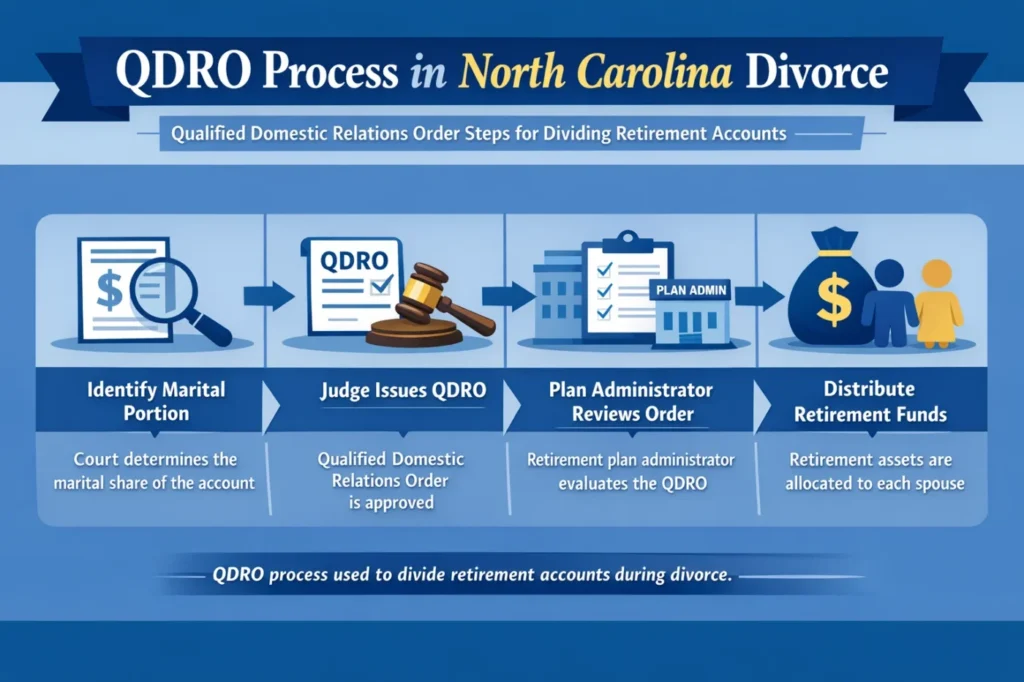
Source: U.S. Department of Labor (Employee Benefits Security Administration) – QDRO Guidance
This process helps ensure that retirement benefits are distributed according to court orders while following the rules of the retirement plan.
Methods Courts Use To Value Retirement Benefits
Courts must determine the value of retirement benefits before dividing them during property distribution. Because retirement plans are structured in different ways, the method used to estimate their value may vary depending on the type of account involved. Some plans provide a current account balance, while others promise future payments after retirement.
Two common valuation approaches are often considered:
- Present value calculation – This method estimates the current value of future retirement benefits based on factors such as expected payment amounts, interest rates, and the time remaining until retirement.
- Deferred distribution – Under this approach, courts divide the retirement payments when the benefits are actually received in the future.
Financial professionals sometimes assist courts in evaluating complex retirement plans, especially when pensions involve long employment histories or future benefit projections. Courts rely on accurate financial documentation when determining the value of retirement benefits, and late disclosures can sometimes affect the evaluation of marital assets during equitable distribution.
How Courts Evaluate Deferred Compensation In Divorce
Deferred compensation plans allow employees to postpone receiving part of their income until retirement or another future date. These plans may appear during divorce proceedings when courts review financial assets accumulated during the marriage. Because deferred compensation may represent income earned over several years, courts evaluate when the compensation was earned and how it relates to the marital timeline. In some situations, reviewing employment records and financial disclosures can also help courts address concerns about hidden assets that may affect equitable distribution.
Courts typically review several factors when evaluating deferred compensation:
- When the income was earned
- Whether the compensation relates to marital employment years
- The schedule for payment distribution
If the compensation was earned during the marriage, that portion may be considered part of the marital estate.
Retirement Plans And Division Considerations
Retirement Plan Type | Typical Distribution Method | Key Consideration |
401(k) | Often divided using QDRO | Contributions during marriage |
Pension | Deferred payment division | Years of service calculation |
IRA | Direct transfer allowed | Account value at separation |
Deferred Compensation | Court allocation | Timing of earned income |
Documents Courts Review For Retirement Account Division
Courts rely on financial documentation when evaluating retirement accounts in divorce cases. These records help identify contributions and determine whether funds are marital property.
Documents commonly reviewed include:
- Account statements showing contribution history
- Employer benefit summaries
- Pension plan descriptions
- Vesting schedules and payment projections
These materials help clarify when retirement savings were accumulated and how they may be evaluated during property division. In some cases, disputes about financial records may arise when one spouse does not provide complete documentation.
What Courts Review When Dividing Retirement Benefits
When evaluating retirement accounts, courts typically consider the financial history of the account and the role it played during the marriage. Before dividing retirement benefits, courts may also examine issues related to asset classification to determine whether the account is treated as marital or separate property.
Factors courts may examine include:
- Length of the marriage
- Timing of contributions
- Account ownership structure
- Applicable federal retirement plan rules
Courts may also review account statements, employment records, and retirement plan documents. These details help judges determine how retirement benefits should be considered within the broader property distribution process during divorce proceedings.
Know More: Separate vs. Marital: When Asset Classification Disputes Force NC Divorces to Trial
How Retirement Accounts Are Addressed In North Carolina Divorce
Retirement savings often represent a significant portion of marital assets. In retirement accounts divorce North Carolina, courts evaluate pensions, 401(k)s, IRAs, and deferred compensation plans to determine which portions were accumulated during the marriage and how they may be addressed in equitable distribution. Documentation such as account statements, contribution records, and employer plan summaries helps courts evaluate the financial history of these accounts.
Understanding how retirement benefits are reviewed can help you follow the financial aspects of divorce proceedings. Some individuals also review topics such as marital asset classification and property distribution when examining the division of retirement benefits.
Speak With North Carolina Divorce Attorneys
If you would like more information about how retirement accounts may be reviewed in divorce proceedings, North Carolina Divorce Attorneys at Martine Law can provide guidance. You may call +1 (704) 255-6992 or visit the Contact Us page at to discuss your situation.
FAQs
Are retirement accounts always divided in a North Carolina divorce?
No. Retirement accounts are not automatically divided in every divorce. In retirement accounts divorce North Carolina, courts first determine whether the account includes marital property. Contributions made before the marriage may remain separate property, while contributions made during the marriage may be considered marital assets. Judges review contribution history, account growth, and employment records when deciding which portion of the retirement account is subject to equitable distribution.
What is the difference between a pension and a 401(k) in divorce?
Yes, there is a difference. A pension usually provides monthly payments after retirement based on years of employment and salary history. A 401(k) is an investment-based retirement account funded by employee and sometimes employer contributions. During a divorce, courts evaluate each plan differently when determining the marital portion and the method used to divide the retirement benefit.
Can retirement accounts be divided without withdrawing money?
Yes. Many employer-sponsored retirement plans can be divided without withdrawing funds through a Qualified Domestic Relations Order. This legal order allows the retirement plan administrator to transfer a portion of the account to the other spouse according to the court’s instructions. Using this process helps distribute retirement benefits while avoiding early withdrawal penalties that might otherwise apply.
Do investment gains count as marital property?
Yes. Investment gains may be considered marital property when they occur during the marriage and relate to contributions made while the spouses were married. Courts typically review account statements, contribution timelines, and growth records to determine how the investment increased over time. In some cases, evaluating separate property may require tracing the financial history of assets to distinguish marital and nonmarital portions.
