

Quick Summary
During divorce proceedings, financial disclosure plays a critical role in determining property division and support obligations. A financial affidavit NC divorce document, provides a sworn summary of income, expenses, assets, and debts. If this information is inaccurate or incomplete, it can affect court evaluations of marital finances. Courts rely on accurate financial affidavits to assess equitable distribution and support calculations, making disclosure accuracy an essential part of the divorce process.
Financial transparency is a central part of divorce proceedings because courts rely on sworn financial statements to evaluate marital finances. A financial affidavit in NC divorce filing provides detailed information about income, assets, debts, and expenses.
When disclosures are incomplete or inaccurate, courts may reassess financial evidence before making decisions about property division or support. In North Carolina family law cases, financial disclosures help courts evaluate economic circumstances during divorce.
North Carolina Divorce Attorneys at Martine Law note that financial affidavits often influence how judges review marital property, debt allocation, and potential support obligations.
Purpose Of Financial Affidavits In Divorce Cases
Financial affidavits provide a detailed summary of each spouse’s financial condition. Courts use these sworn statements to review income, debts, and property ownership during divorce.
These affidavits help establish a financial baseline used in property division and support discussions.
Monthly Income From Employment Or Other Sources
Courts review salary, bonuses, business earnings, and other income sources to assess financial capacity during divorce proceedings.
Living Expenses And Recurring Financial Obligations
Reported monthly expenses such as housing, utilities, and insurance help the court evaluate ongoing financial responsibilities and household needs.
Real Estate And Personal Property Ownership
Property ownership disclosures allow the court to identify assets that may be reviewed when disputes arise about asset tracing during divorce proceedings.
Outstanding Debts And Liabilities
Financial affidavits also include credit card balances, personal loans, mortgages, and other liabilities connected to the marital financial picture.
In a financial affidavit NC divorce filing, these disclosures help courts understand the full scope of financial obligations that may affect property division and financial determinations.
Retirement Accounts Or Investment Assets
Courts review retirement savings, pension plans, and investment portfolios when examining the financial resources available to each spouse.
Accurate disclosure ensures the court can evaluate financial positions fairly.
Information Typically Required In Financial Disclosure
Courts require parties to present a clear financial picture during divorce proceedings. A financial affidavit organizes financial information into structured categories so judges can review income, assets, expenses, and liabilities in a consistent format.
These disclosures help courts evaluate financial circumstances before making determinations related to property distribution or financial responsibilities.
Key information commonly requested includes:
Financial Category | Examples of Required Details |
Income Sources | Salary or wages, bonuses, commissions, overtime pay, self-employment income, rental income, investment income, government benefits, and other recurring earnings |
Living Expenses | Housing payments, utilities, groceries, insurance premiums, transportation costs, childcare expenses, medical costs, education expenses, and personal spending |
Assets | Primary residence, vacation property, vehicles, bank accounts, cash savings, personal property, business interests, and valuable collectibles |
Debts | Credit card balances, personal loans, mortgages, auto loans, student loans, medical debt, tax liabilities, and other outstanding financial obligations |
Investments | Retirement accounts such as 401(k) or IRA, brokerage accounts, stocks, bonds, mutual funds, annuities, and other long-term investment holdings |
Courts may review these financial categories alongside supporting documentation such as tax returns, bank statements, and loan records used in equitable distribution cases.
Accurate entries help ensure the affidavit reflects the actual financial circumstances presented in the case and allow the court to assess financial matters more objectively during divorce proceedings.
How Courts Review Affidavit Accuracy During Divorce
Courts do not rely on financial affidavits alone. Judges review these disclosures together with supporting financial records to determine whether the reported income, assets, and debts reflect the parties’ actual financial situation.
The visual guide below shows the most common documents courts use when reviewing affidavit accuracy in divorce cases.
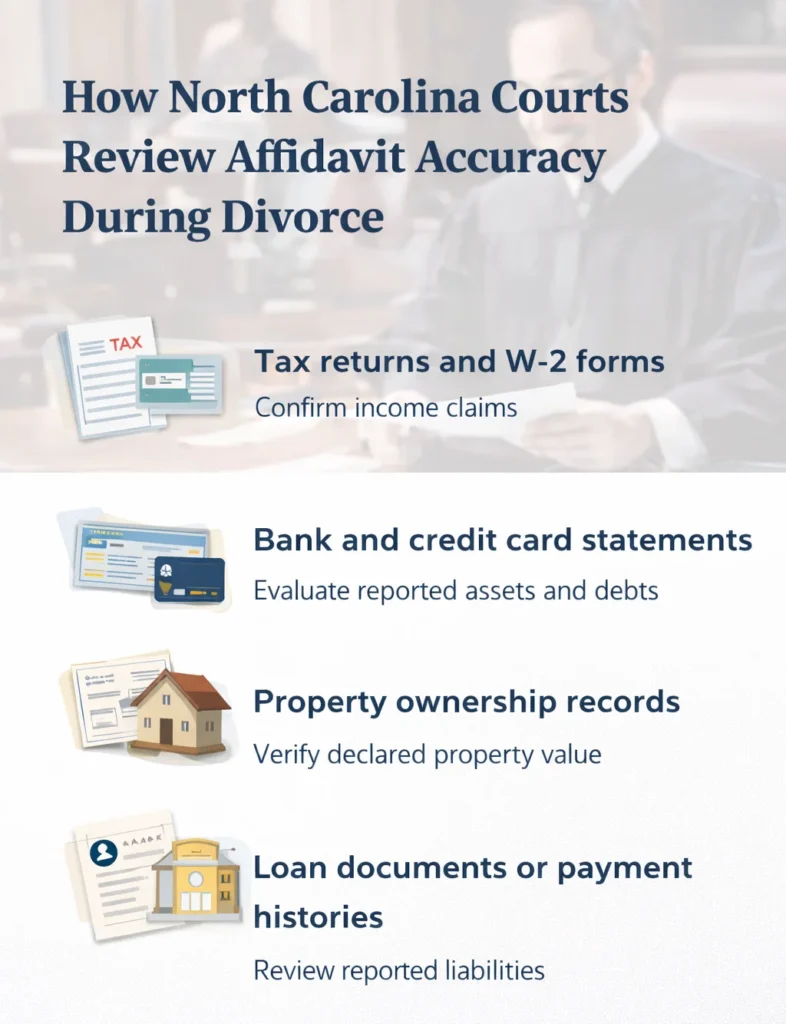
Source: North Carolina General Assembly. (n.d.). N.C. Gen. Stat. § 50-16.3A – Alimony.
Common verification sources include:
- Tax returns and W-2 forms – Used to confirm reported income and employment earnings.
- Bank and credit card statements – Help identify spending patterns, account balances, and undisclosed assets.
- Property ownership records – Verify whether real estate or other titled property has been accurately disclosed.
- Loan documents or payment histories – Provide evidence of outstanding debts and financial obligations.
Courts may compare statements in the financial affidavit with supporting records to determine whether the disclosures are consistent.
In a financial affidavit NC divorce filing, discrepancies between reported information and financial documents may prompt judges to request clarification or require additional documentation before making decisions related to property division or support.
Consequences Of Inaccurate Financial Disclosure In Divorce
Inaccurate disclosure may affect how the court evaluates financial issues during divorce. Judges rely on truthful financial information to assess fairness in property division and support.
Potential outcomes when inaccuracies are identified include:
- Requests for corrected financial statements
- Increased scrutiny of financial records
- Delays in financial determinations
- Adjustments in how financial claims are evaluated
Courts expect affidavits to reflect complete and honest financial information because decisions may depend on those disclosures.
Know more: What Happens When Financial Records Go Missing During an NC Divorce
Role Of Financial Disclosure In Property Division
Financial affidavits provide important context when courts divide marital property in a North Carolina divorce. A financial affidavit NC divorce filing helps judges review disclosed assets and debts to determine which property belongs to the marital estate and how it should be divided.
Accurate financial disclosure is especially important when evaluating property division issues under North Carolina’s equitable distribution framework.
Property Acquired During The Marriage
Courts review property obtained while the spouses were married to determine whether it qualifies as marital property. Assets acquired during the marriage are generally included in the marital estate unless they meet the criteria for separate property.
Debt Accumulated While Married
Financial affidavits also identify debts incurred during the marriage. Courts examine whether obligations such as credit cards, personal loans, or mortgages were accumulated for marital purposes.
Value Of Marital Assets At Separation
The value of marital assets at the time of separation often plays a role in property division decisions. Courts may consider appraisals, financial statements, or other documentation to determine the value of assets included in the marital estate.
Changes In Asset Value Before Distribution
In some cases, courts also review changes in asset value between the date of separation and the date of distribution. Financial disclosures help identify increases or decreases in value that may affect how property is ultimately divided.
Financial Affidavits And Support Determination Factors
Courts also rely on financial affidavits when examining potential support obligations. Income and expenses listed in the affidavit may be considered when reviewing financial capacity.
Financial disclosures can contribute to evaluating matters such as:
- Household financial needs – Courts may review regular living costs such as housing, utilities, and daily necessities when assessing overall financial needs.
- Relative income between spouses – Income disclosures allow courts to compare each spouse’s earning capacity and financial resources.
- Existing financial responsibilities – Ongoing financial duties, including debts or required payments, may be considered when evaluating financial capacity.
- Long-term financial obligations – Courts may also review extended financial responsibilities that affect long-term financial stability.
These financial details help courts review overall financial capacity and determine how support considerations may apply based on the documented financial circumstances of both parties.
Documentation Supporting Financial Affidavit Statements
Financial affidavits represent sworn statements, but courts often expect documentation that supports the financial information provided. These materials help verify income, assets, and liabilities, and may reveal discrepancies that raise concerns about hidden assets during divorce proceedings.
Supporting materials may include:
- Employment income records – Pay stubs, employer statements, or tax documents may be reviewed to confirm the income reported in the financial affidavit.
- Financial account summaries – Bank and investment account summaries help courts verify balances, account activity, and whether financial assets were fully disclosed.
- Mortgage or loan statements – These records may show outstanding debt obligations, payment history, and the financial responsibilities associated with real estate or other loans.
- Property valuation documents – Appraisals or valuation reports may help establish the current or historical value of assets included in the marital estate.
Why Accurate Financial Disclosure Matters In Divorce
Accurate financial disclosure helps courts review financial circumstances clearly during divorce proceedings. When spouses provide complete details about income, expenses, assets, and debts, judges can better evaluate property division and financial obligations.
A properly prepared financial affidavit NC divorce document organizes financial information in a consistent format that supports court review. Reliable disclosures also reduce the likelihood of delays caused by incomplete records or requests for additional documentation.
Maintaining accurate financial information helps ensure that financial determinations reflect the actual financial situation of both parties.
Find the Right North Carolina Custody Attorney for Your Situation
If you have questions about preparing a financial affidavit document or reviewing financial disclosures, you may speak with the North Carolina Divorce Attorneys at Martine Law at +1 (704) 255-6992 or visit the Contact Us page for additional information.
FAQs
Can a court question information in a financial affidavit?
Yes. Courts may question affidavit entries if financial records or supporting documents appear inconsistent. Judges often compare the information listed in the affidavit with bank statements, tax returns, employment records, and other financial documents. If discrepancies appear, the court may request clarification or additional documentation before relying on the financial information presented during divorce proceedings.
Is financial disclosure required in every North Carolina divorce?
Yes. Financial disclosure is generally required when divorce cases involve financial matters such as property division, spousal support, or child support. Courts rely on sworn financial statements from both spouses to review income, assets, expenses, and debts. These disclosures help establish a financial overview that allows judges to examine financial circumstances before making decisions related to marital finances.
Can incomplete financial records delay divorce proceedings?
Yes. Incomplete financial records can delay divorce proceedings because courts often need a full financial picture before reviewing property or support matters. When documentation is missing or unclear, judges may request updated affidavits or additional records. This process can extend the timeline of the financial review while the court waits for accurate and complete financial information.
What happens if debts are not disclosed in a financial affidavit during divorce?
If debts are omitted from a financial affidavit, the court may not have a complete picture of the marital financial situation. Missing liabilities can affect how assets and responsibilities are evaluated during property division. Undisclosed obligations may create discrepancies that require clarification, particularly when reviewing issues related to hidden liabilities in financial disclosures.
