

Quick Summary
When you experience school registration delays after separation, school enrollment custody North Carolina rules determine which parent can make enrollment decisions. Courts review custody orders, parental cooperation, and educational authority when deciding how school placement decisions should be handled.
Delays in school enrollment after separation often occur when parents disagree about where a child should attend school. In school enrollment custody North Carolina disputes, courts determine which parent has authority to make education decisions when custody orders do not clearly resolve the issue.
These disagreements can affect school registration timelines, transportation arrangements, and the child’s academic stability. Courts examine legal custody structures and communication between parents before deciding how educational decision making authority NC applies to school enrollment conflicts. North Carolina Divorce Attorneys at Martine Law regularly help individuals understand how courts review education disputes and clarify parental authority in custody matters.
Why Do School Enrollment Delays Occur After Separation
School enrollment delays commonly happen when separated parents cannot agree about the child’s school placement. Disagreements may involve school districts, relocation concerns, or conflicting interpretations of custody orders.
When parents share legal custody, both may believe they have equal authority to choose the school. However, if parents cannot agree, enrollment decisions may stall while the dispute remains unresolved.
Courts examine whether the custody order clearly defines decision-making authority. Judges also review whether parents attempted to communicate about the school choice before the enrollment deadline. If communication breaks down, the disagreement may delay registration and disrupt the child’s academic schedule.
For general information about custody and parental rights, the North Carolina Judicial Branch provides an overview of custody law and decision-making authority.
How Do North Carolina Courts Decide Educational Authority
North Carolina courts determine educational authority by reviewing the custody order and the legal custody arrangement, particularly when disputes arise under custody orders that define parental decision-making responsibilities.
If parents share joint legal custody, courts usually expect both parents to participate in major decisions such as school selection and enrollment. When disagreements arise, judges examine communication between parents and whether either parent acted without consultation.
Courts typically review several factors when determining educational authority:
Factor Reviewed | What Courts Look For |
Custody Order Language | Who has decision authority |
Current School Placement | Stability and continuity |
Parent Participation | Communication and involvement |
Impact on Routine | Daily schedule and consistency |
These evaluations help courts determine whether educational decision making authority NC was exercised according to the custody order.
What Do Judges Review During Enrollment Disputes
Courts review practical details surrounding school enrollment decisions. Judges focus on whether the enrollment choice supports the child’s educational continuity and daily routine.
Courts often analyze several key factors when reviewing enrollment disputes:
- The child’s current school placement and academic stability
- Communication between parents regarding enrollment decisions
- Transportation logistics and distance between households
- Whether the enrollment decision affects the existing custody arrangement
Judges may review communication records, previous school attendance, and how each parent handled discussions about enrollment. Transportation logistics also play a role in court evaluations, especially when school choice increases travel time or interferes with parenting schedules.
These reviews help courts determine whether a parent’s decision aligns with the child’s best interests while remaining consistent with the custody order.
How Can School Enrollment Custody North Carolina Disputes Affect Parenting Plans
School placement decisions can directly affect parenting schedules because school location determines daily routines and transportation responsibilities. When one parent enrolls a child in a distant school district, the decision may affect travel time for parenting exchanges.
In school enrollment custody North Carolina disputes, courts review whether the enrollment choice interferes with the existing parenting plan. Judges may consider whether the school location increases logistical challenges for exchanges or extracurricular participation.
Courts also evaluate how school placement influences the child’s daily schedule, especially when disputes affect established parenting time schedules that determine transportation responsibilities between parents.
Changes to school location may affect before-school care, after-school activities, and transportation duties. Because of these practical consequences, judges often prioritize solutions that maintain educational stability while preserving the structure of the custody order.
When May Courts Clarify Educational Authority
Courts may clarify educational authority when custody orders do not clearly define which parent controls school decisions. This situation often occurs when repeated disputes delay school enrollment or interrupt educational planning.
Judges review the custody order to determine whether the document already assigns responsibility for education decisions. If the order lacks clear language, the court may clarify how future decisions must be made.
Courts may address these disputes by:
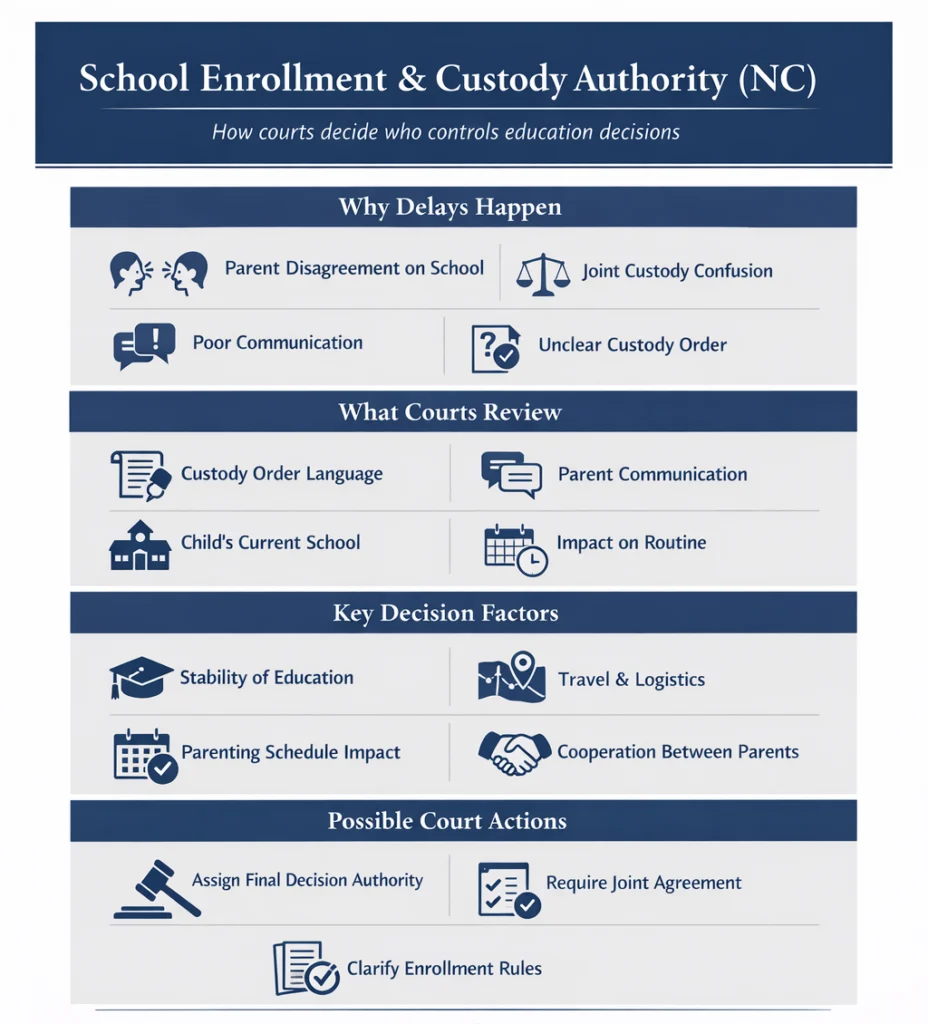
North Carolina custody law allows courts to evaluate parental authority and determine decisions that support the child’s welfare. Additional information about custody authority appears in the state statute governing custody determinations.
This topic explains how courts address situations where parents share legal custody but cannot agree on major decisions such as education, healthcare, or school enrollment.
Know More – Legal Custody Impasses: How NC Courts Break the Tie on School and Medical Decisions
How Do Enrollment Conflicts Influence Custody Proceedings
Enrollment conflicts sometimes become part of broader custody proceedings. Courts may review these disagreements when evaluating how parents cooperate under a custody order.
If disputes repeatedly delay school registration, judges may examine whether the custody arrangement functions effectively. Courts often review communication records and previous enrollment discussions to determine whether both parents participated in the decision-making process.
However, a single disagreement about school placement does not automatically lead to custody modification. Courts focus primarily on maintaining educational stability while ensuring the custody order is followed correctly.
Repeated enrollment conflicts may prompt courts to clarify educational authority or establish clearer guidelines for future decisions.
How School Enrollment Disputes Shape Custody Outcomes
School enrollment disagreements often reveal how custody orders allocate responsibility for major decisions. Courts review the custody order, parental communication, and whether decisions follow the legal structure of custody arrangements.
When parents disagree about school placement, judges evaluate how the decision affects the child’s academic stability and daily routine. Courts also consider whether parents attempted to cooperate before making enrollment decisions.
These disputes sometimes highlight gaps in custody orders. When an order lacks clear direction about educational authority, courts may provide clarification to prevent similar conflicts in the future.
Understanding how courts review enrollment disputes helps explain why documentation, communication records, and custody order language often influence how these cases develop.
Guidance When Educational Authority Questions Arise
Questions about school enrollment authority often arise when custody orders do not clearly define which parent controls educational decisions. Courts examine legal custody arrangements, communication between parents, and the child’s academic stability before clarifying responsibility.
If you need guidance about how school enrollment decisions may be evaluated in your situation, you may contact North Carolina Divorce Attorneys at Martine Law at +1(704)-255-6992 or visit the Contact Us page to learn more.
FAQs
Can one parent enroll a child in school without the other parent’s consent?
Yes. A parent may enroll a child without the other parent’s consent if the custody order grants that parent final authority over educational decisions. When parents share joint legal custody, courts usually expect both parents to participate in enrollment decisions. Judges may review communication records and the custody order when determining whether the decision followed court requirements.
Do custody orders normally define school decision authority?
Yes. Custody orders often contain provisions describing how major educational decisions must be handled. These provisions explain whether parents must reach joint agreement or whether one parent has final authority. Courts interpret these terms when applying educational decision making authority NC to school enrollment disputes and evaluating whether each parent followed the responsibilities defined in the custody order.
What happens if parents cannot agree on a school?
Yes. Courts may intervene when parents cannot agree on school placement after separation. Judges review the custody order, the child’s educational stability, and the practical effects of the proposed school options. Courts may also examine communication between parents to determine whether either parent attempted to enroll the child without consulting the other parent first.
Can repeated school disputes affect custody decisions?
Yes. Courts may consider repeated school enrollment disputes when evaluating parental cooperation under a custody order. If disagreements frequently delay enrollment or disrupt the child’s routine, judges may review whether the order clearly defines decision-making authority. Courts may clarify educational decision making authority NC to reduce future conflicts about school placement decisions.
Are enrollment disputes common in school enrollment custody North Carolina cases?
Yes. Enrollment disagreements are relatively common in school enrollment custody North Carolina disputes when parents share joint legal custody. Courts frequently review custody orders to determine whether both parents must agree on school decisions or whether one parent holds final authority for enrollment decisions. Courts often examine how courts apply the best interest standard in custody decisions when evaluating school placement disputes.
