

Quick Summary
When you request a custody change in North Carolina, your past compliance with court orders can influence how a judge evaluates your request. Courts reviewing enforcement records custody modification NC cases often look at patterns of missed parenting time, communication disputes, or prior contempt issues. These records may shape how much flexibility a judge shows when deciding whether modifying an existing custody order is appropriate.
When parents ask a court to change an existing custody order, judges often review how both parties followed the original order. In many enforcement records custody modification in NC cases, courts examine prior enforcement actions to determine whether the current custody arrangement is working as intended. A history of compliance may support stability, while repeated violations or disputes may raise concerns about how the order functions in practice.
Judges may develop what is sometimes described as judicial tolerance custody NC, meaning the court evaluates whether past violations were isolated or part of a continuing pattern. Enforcement records help the court see whether disputes between parents are temporary issues or ongoing problems affecting the child’s routine and stability.
Because these records can influence how modification requests are interpreted, understanding how courts review enforcement history is important before pursuing changes to a custody order. North Carolina Divorce Attorneys at Martine Law assist parents by explaining how custody orders, enforcement actions, and modification requests are evaluated under North Carolina family law.
What Are Enforcement Records in NC Custody Cases?
Enforcement records refer to court filings and orders that document whether parents followed an existing custody or visitation order. When modification requests are filed, judges often review these records to understand how the order has functioned over time.
These records may include several types of documented disputes or court actions, such as:
Enforcement Record Type | What It Documents |
Contempt Motions | Missed parenting time violations |
Visitation Violation Orders | Failure to follow custody schedules |
Scheduling Conflict Records | Ongoing disputes about exchanges |
Failed Custody Exchanges | Missed or denied visitation |
Court Warnings | Judicial corrective orders after hearings |
Judges rely on these records because they provide an objective history of how the custody order has operated in practice. Rather than relying only on testimony, courts review documented events that show whether each parent complied with the order.
For a deeper look at how enforcement disputes may arise during custody cases, see Know More – Civil Contempt in Custody Enforcement in North Carolina
The North Carolina Judicial Branch also provides general information about custody and enforcement procedures.
How Do Enforcement Records Affect Custody Modification Decisions?
When a parent files a motion to modify custody, the court must determine whether circumstances have changed enough to justify altering the existing order. Enforcement history often plays a role in that analysis.
Judges review enforcement records to evaluate whether the custody arrangement is functioning effectively for the child. Repeated violations or unresolved conflicts may signal that the current order is no longer workable.
Courts may look for patterns such as ongoing parenting-time disputes or repeated noncompliance. However, a single enforcement issue may carry less weight if it was resolved quickly or did not significantly affect the child.
Parents dealing with enforcement disputes sometimes review how existing custody orders are structured to understand whether changes may be necessary.
Why Do Judges Consider Judicial Tolerance in NC Custody Disputes?
Judicial tolerance refers to the level of flexibility or concern a judge may show when reviewing enforcement issues during a custody case. Courts recognize that occasional misunderstandings or scheduling conflicts can occur between parents.
However, when reviewing judicial tolerance custody NC, judges often consider whether enforcement disputes show a temporary conflict or a continuing pattern of behavior.
Courts may ask several questions when evaluating tolerance levels:
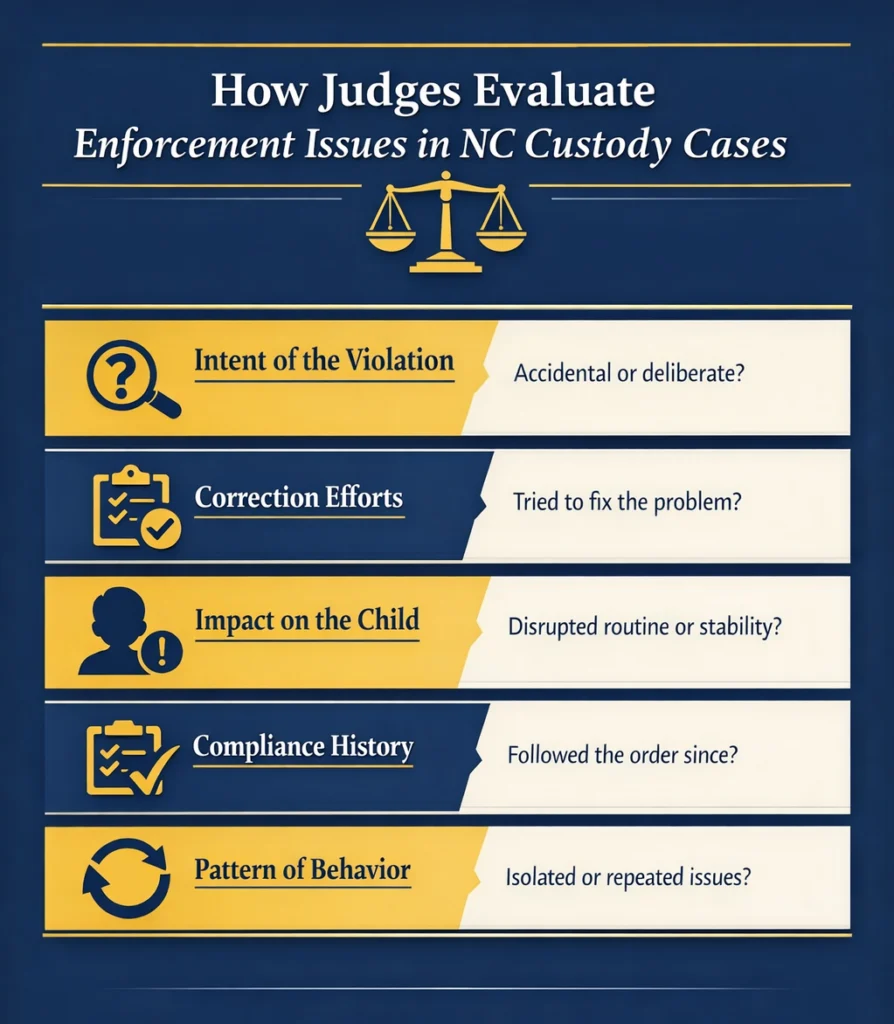
Source: Modification of order for child support or custody.
When enforcement issues appear isolated, courts may treat them as temporary disagreements. When they occur repeatedly, they may carry greater weight in modification decisions.
When Can Enforcement Records Support a Custody Modification?
In some situations, enforcement history may support a request to change custody arrangements. Courts may consider whether repeated violations suggest that the current order is not working effectively.
For example, enforcement records may become relevant when one parent consistently fails to follow parenting-time requirements or repeatedly disrupts scheduled exchanges. Judges may view these situations as evidence that the custody arrangement needs adjustment.
In more urgent situations where disputes escalate quickly, courts may also review whether emergency custody actions were previously requested.
However, courts still focus on the child’s best interests when reviewing modification requests. Enforcement history alone does not automatically result in a custody change, but it can help the court understand whether ongoing conflicts are affecting the child’s daily life.
What Other Evidence Do Courts Review Along With Enforcement Records?
Enforcement history is only one part of the information courts review when considering a custody modification. Judges often evaluate additional evidence to determine whether a change in circumstances has occurred.
Relevant information may include school schedules, communication records between parents, and documentation showing how the child’s routine has been affected by ongoing disputes.
Courts may also review whether each parent attempted to resolve conflicts without court intervention. Consistent cooperation and documented efforts to follow the order may influence how judges interpret enforcement history.
Additional information about custody laws in North Carolina can be found through the state legislature.
How Can Parents Evaluate Enforcement Records Before Filing a Modification?
Before requesting a custody modification, many parents review their enforcement history to determine how the court may interpret prior disputes. Patterns of communication, compliance, and documented attempts to resolve disagreements may influence the court’s analysis.
If enforcement disputes have occurred, courts may consider whether the issues were resolved and whether both parents made efforts to follow the order afterward.
If you want to explore how your custody history may affect a modification request, you may speak with a family law attorney to have your case reviewed.
What Enforcement Records May Mean for Your NC Custody Modification Case
When courts evaluate custody modifications, enforcement history can help judges understand how the existing order has worked over time. Records of compliance, cooperation, and resolved disputes may show that the order remains functional. However, repeated enforcement issues may indicate that the arrangement requires adjustment to support the child’s stability.
Judges reviewing these records consider whether violations were isolated events or part of a larger pattern. Courts also examine whether parents made efforts to correct problems and maintain consistent parenting schedules after enforcement disputes occurred.
Because enforcement records interact with other factors such as parenting cooperation and the child’s routine, reviewing your case history before filing a modification request can provide helpful clarity. North Carolina Divorce Attorneys at Martine Law can explain how courts evaluate these issues and how custody modification requests may be reviewed. Call +1(704)-255-6992 or visit the Contact Us page to discuss your situation.
FAQs
Can enforcement records influence custody modification decisions in North Carolina?
Yes. Courts often review enforcement records when deciding whether to modify a custody order. Judges examine whether either parent repeatedly violated the existing order or whether disputes were resolved without ongoing conflict. Enforcement records help the court determine whether the current arrangement remains workable and whether the child’s routine has been disrupted by repeated custody disputes.
Do courts always review enforcement records in custody cases?
Yes. Courts frequently review enforcement history, particularly compliance with existing terms, when custody modifications are requested. Judges use these records to determine whether either parent consistently followed the existing custody order. This documentation helps the court identify patterns of compliance or conflict that may influence whether a change in custody arrangements is appropriate.
Can past custody violations affect how judges evaluate parents?
Yes. Prior violations may influence how a judge interprets credibility and compliance in a custody case. If enforcement disputes occur repeatedly, courts may examine whether those issues affected the child’s stability or daily routine. However, isolated incidents that were corrected quickly may carry less weight in the court’s overall evaluation.
Does judicial tolerance affect custody rulings in North Carolina?
Yes. Judicial tolerance in custody NC refers to how family law judges interpret past violations when evaluating custody disputes. Courts often consider whether enforcement issues were temporary misunderstandings or part of a consistent pattern of noncompliance. This evaluation helps determine whether the current custody arrangement remains effective for the child.
Should you speak with a lawyer before requesting a custody modification?
Yes. Reviewing enforcement records custody modification NC cases with a family law attorney can help clarify how courts may interpret past custody disputes. Enforcement history, communication records, and compliance patterns may all influence a judge’s decision. To discuss your situation, contact North Carolina Divorce Attorneys at Martine Law at +1(704)-255-6992 or visit the Contact Us page for additional guidance.
