

Quick Summary
A guardian ad litem report in North Carolina custody cases provides judges with an independent evaluation of a child’s circumstances during contested custody disputes. You may see the GAL review parenting environments, interview family members, and examine school or medical information. Courts often review the report to understand stability, communication patterns, and the child’s daily life before making custody decisions.
A guardian ad litem report in North Carolina custody cases helps judges review independent information about a child’s situation during contested custody disputes.
These reports summarize interviews, home observations, and records reviewed by the guardian ad litem to assist the court in evaluating the child’s best interests.
Judges often review GAL findings alongside testimony, evidence, and custody statutes to understand family dynamics and parenting arrangements. While the report does not determine the outcome, it provides context about the child’s environment, routines, and relationships.
North Carolina Divorce Attorneys at Martine Law note that GAL reports help courts review custody disputes.
Role Of Guardian Ad Litem In Custody Cases
A guardian ad litem represents the child’s perspective during contested custody proceedings. The role focuses on gathering information and presenting findings that help the court evaluate the child’s circumstances.
In GAL report custody NC situations, the guardian ad litem may examine:
- Living conditions in each household
- The child’s school and daily routines
- Communication between parents and caregivers
- Observations of the child’s relationships with family members
The report summarizes these observations so the judge can better understand how each environment affects the child. Courts often rely on findings from the state’s GAL program to review information collected during custody and child welfare cases
Types Of Information Included In GAL Reports
A guardian ad litem report compiles several forms of information gathered during the investigation process. These details help the court understand the child’s living conditions, relationships, and daily routines during a custody dispute.
In a guardian ad litem report in North Carolina custody cases, the guardian may review interviews, observations, and official records that describe the child’s environment and the involvement of each parent. This information helps the court evaluate how different household factors may affect the child’s well-being and stability.
Information Reviewed | What the Guardian Ad Litem Examines | Why Courts Review It |
Parent and Witness Interviews | Conversations with parents, relatives, teachers, or other caregivers | Provides context about parenting roles and family dynamics |
Home Observations | Living conditions, safety, and routines in each household | Helps assess stability and daily caregiving environments |
School Records | Attendance, academic performance, and teacher feedback | Shows how the child is functioning in school routines |
Medical or Counseling Records | Health history, therapy notes, or treatment details when relevant | Helps the court understand emotional or physical needs |
Parenting Schedules and Communication | Existing parenting time arrangements and communication between parents | Provides insight into cooperation and caregiving consistency |
Together, these elements create a structured summary of the child’s environment and relationships. The guardian ad litem presents this information to assist the court in understanding how different factors may influence custody decisions.
How Judges Review the GAL Report Findings
Judges review GAL reports as informational evidence rather than automatic conclusions. The court compares the report’s observations with testimony, documents, and other evidence presented during the case.
Comparing GAL Observations With Court Evidence
Judges often evaluate whether the information in the report aligns with testimony and records introduced during the custody hearing. Consistency between these sources helps the court determine how much weight to give the report.
Common areas judges evaluate include:
- Consistency between the report and courtroom testimony
- Evidence supporting the guardian’s observations
- Parenting stability in each household
- The child’s emotional and developmental needs
Because the report reflects only one stage of the investigation process, judges review it together with the broader case record and legal standards applied in custody proceedings. These findings may also influence decisions involving physical custody, particularly when courts examine which household provides stability, routine, and daily care for the child.
Credibility And Supporting Documentation In Custody Cases
Courts also examine the credibility of the information included in the report. Judges may review how the guardian gathered details, which witnesses were interviewed, and whether supporting records confirm the findings.
In many custody cases, documentation such as school records or communication logs may reinforce or clarify statements contained in the report.
Additional materials, including social media evidence, may also be reviewed to understand how daily interactions, communication patterns, or household dynamics affect the child’s environment.
Know More: How Negative Text Messages and Social Media Posts Hurt Your NC Custody Case
Factors That Often Influence the Court's Interpretation
Courts often focus on recurring patterns when interpreting GAL findings. These patterns help judges determine whether the report aligns with the broader evidence presented in the custody dispute.
Stability And Routine In The Child’s Life
Stability is one of the most closely examined elements when courts review custody information. Judges frequently evaluate whether the child’s routines, schooling, and caregiving patterns remain consistent between households.
Several elements frequently influence how judges interpret the report:
- Stability of the child’s living arrangements
- Cooperation between parents in decision-making
- Safety concerns or environmental risks
- Continuity in school, activities, and routines
When evaluating these elements, courts may also consider how existing routines influence the child’s emotional and academic stability. In many situations, maintaining the child’s status quo can play a role in how judges view continuity and long-term custody arrangements.
Know More: The Status Quo Effect: How Temporary Parenting Schedules Determine Final Custody in NC
Parental Communication And Cooperation In Custody
Another factor courts consider is how parents communicate about the child’s needs. GAL reports often document whether parents share information about education, medical decisions, and extracurricular activities.
Patterns of cooperation or conflict may help judges understand how each parent contributes to the child’s overall support system. These observations can become particularly relevant in cases where long-term co-parenting arrangements are being evaluated.
Limitations Of the Guardian Ad Litem Reports
Although important, a GAL report does not determine the final custody outcome. The judge retains full authority to weigh all evidence presented in the case.
Reports Reflect A Limited Investigation Period
A GAL report summarizes information gathered during a specific investigation timeframe. Because family dynamics change, the report represents a snapshot rather than a complete history of parenting relationships.
Some limitations of GAL reports include:
- The report reflects information available during the investigation period
- Interviews may represent only a portion of relevant witnesses
- Observations capture limited moments in family dynamics
Judicial Discretion In Interpreting the Findings
Courts maintain discretion when evaluating how much weight to give a report. Judges may consider whether the report’s conclusions are supported by testimony, documentation, or other evidence presented during the case.
Because of these limitations, courts treat GAL reports as one component of the evidentiary record rather than a standalone decision-making tool.
How GAL Reports Interact With Other Custody Evidence
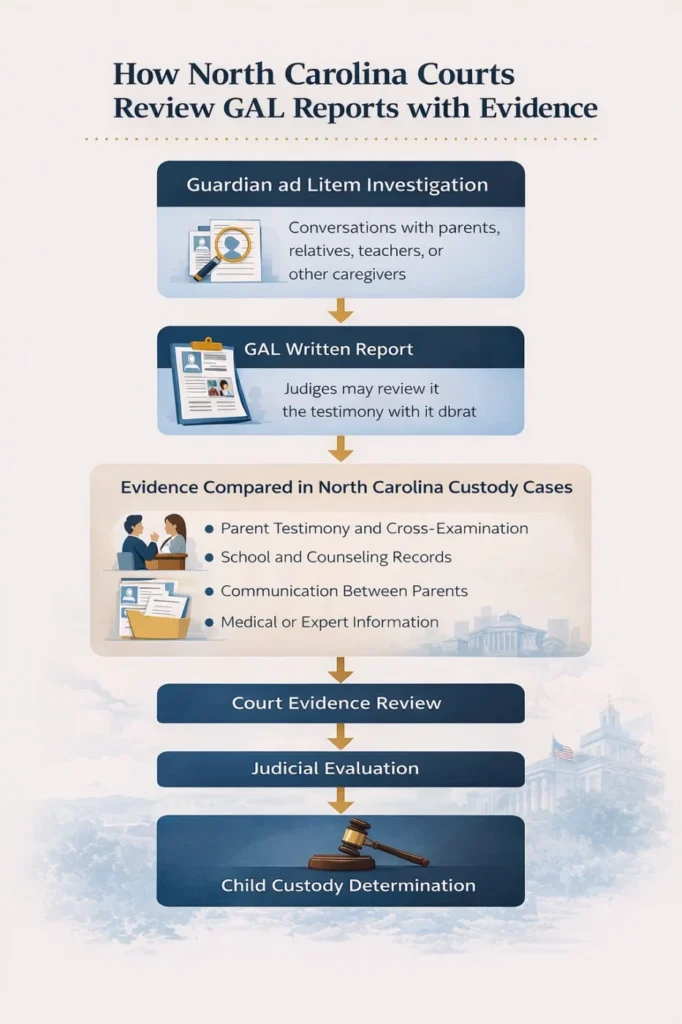
A guardian ad litem report usually works alongside several other forms of evidence in contested custody hearings. Judges compare the report with testimony, documents, and expert input before determining how it fits within the overall case.
Because custody decisions rely on multiple sources of information, courts review the GAL report together with statements from witnesses, records from schools or medical providers, and communication history between parents. These materials may also be considered when courts evaluate custody orders, which establish the legal framework for parenting arrangements and decision-making responsibilities in North Carolina custody cases.
Combining the Investigative Findings With Testimony
Court hearings often involve testimony from parents, teachers, medical professionals, and other witnesses. Judges may compare this testimony with statements summarized in the guardian ad litem report to determine whether the observations align with other evidence presented during the case.
Evidence commonly reviewed together with GAL reports includes:
- Parent testimony and cross-examination
- School or counseling records
- Communication records between parents
- Statements from teachers or medical professionals
Source: North Carolina General Statutes §7B-601
Building Complete View Of The Child’s Circumstances
When all evidence is reviewed together, the court gains a broader picture of the child’s environment. The GAL report can help organize investigative findings, while other evidence may confirm or challenge those observations.
This combined review helps the court form a more complete understanding of the child’s circumstances before making a custody determination
Understanding How Courts Use GAL Reports
A guardian ad litem report in North Carolina custody cases helps courts review information about the child’s environment, relationships, and daily life during contested custody disputes. Judges examine the report alongside testimony, records, and other evidence to better understand the child’s circumstances before making custody decisions.
Because the report summarizes observations gathered during the investigation process, it often provides context about family dynamics, parenting routines, and communication patterns.
However, it remains only one part of the court’s overall evaluation. Custody outcomes depend on the full set of evidence presented during the case.
Understanding Custody Investigations In North Carolina Courts
If you want to better understand how custody investigations and court evaluations work in North Carolina, North Carolina Divorce Attorneys at Martine Law can provide general guidance about the legal process. You may call +1 (704) 255-6992 or visit the Contact Us page for guidance.
FAQs
What does a guardian ad litem do in custody cases?
Yes. A guardian ad litem investigates circumstances affecting a child during contested custody disputes. The GAL may interview parents, observe the child’s living environment, and review school or medical records. The resulting guardian ad litem report in North Carolina custody cases summarizes those findings so the court can better understand the child’s situation when evaluating custody arrangements.
How long does a GAL investigation usually take?
No. There is no fixed timeline for a GAL investigation. The length can vary depending on the complexity of the custody dispute and the number of individuals involved. Many investigations take several weeks or months because the guardian ad litem must conduct interviews, review records, and observe family environments before completing the GAL report custody NC findings.
Can parents challenge a guardian ad litem report?
Yes. Parents may question or challenge information contained in a GAL report during custody hearings. Attorneys may review interview summaries, supporting documents, and investigative methods to examine the accuracy of the report’s conclusions. Courts may also review related issues affecting custody modification, particularly when past disputes or enforcement concerns influence later requests for changes.
Are GAL reports confidential in North Carolina custody cases?
Yes. GAL reports are typically filed with the court and shared with the parties involved in the custody case. However, they often contain sensitive information about the child, family relationships, or medical history. Because of this, courts may limit broader public access to the report to help protect the child’s privacy and the confidentiality of the individuals referenced in the investigation.
