

Quick Summary
Courts often review conduct that occurs shortly before a custody trial. In late stage litigation choices custody in NC situations, judges may evaluate timing, compliance with prior orders, and new allegations. Through judicial discretion custody, courts assess whether these actions reflect legitimate concerns or strategic litigation behavior.
As custody cases approach trial, courts often examine how each party’s actions align with earlier filings, court orders, and documented concerns. Decisions made during the final stage of litigation can influence how judges evaluate credibility and stability in the case record.
In matters involving late stage litigation choices custody NC, courts may review emergency motions, compliance with temporary orders, or newly raised allegations to determine whether those developments reflect genuine issues affecting the child. Judges apply judicial discretion custody when assessing these circumstances, weighing the timing and consistency of each party’s conduct alongside the broader case history.
North Carolina Divorce Attorneys at Martine Law often explain how courts analyze litigation conduct when evaluating evidence and credibility in custody proceedings approaching trial
Why Does Timing Matter So Much Before a Custody Trial?
Timing matters because judges expect stability and consistency as trial approaches. When a parent introduces new allegations, files emergency motions, or alters parenting positions close to a hearing date, the court will assess whether the issue genuinely arose recently or could have been addressed earlier.
Under North Carolina law, custody determinations must serve the child’s best interests pursuant to N.C. Gen. Stat. § 50-13.2, which allows courts broad authority to evaluate relevant circumstances. When late filings appear reactive rather than necessary, judges may question credibility.
Courts also consider:
- Whether prior concerns were documented and communicated
- Whether the parent complied with temporary custody or support orders
A pattern of stability often weighs differently than sudden changes without documented cause.
What Late Stage Litigation Choices Custody NC Judges Review Most Closely?
Certain decisions consistently draw judicial attention in the weeks or months leading up to trial. Emergency motions filed shortly before a hearing are closely examined to determine whether they meet the legal standard for immediate risk or harm, or whether they appear tactical. Courts expect emergencies to reflect genuine urgency, not strategic timing.
Last-minute custody modification requests also receive scrutiny. Because modification requires a substantial change in circumstances, raising the issue near trial without documented developments may lead a judge to question timing and intent.
Similarly, new allegations introduced shortly before court are evaluated in light of prior communication. Judges often look for evidence that concerns were previously reported to schools, medical providers, or documented through parenting communication platforms.
Noncompliance with temporary custody, support, or discovery orders may influence how the court applies judicial discretion custody NC when assessing reliability and respect for court authority.
In equitable distribution matters governed by N.C. Gen. Stat. § 50-20, incomplete or inconsistent financial disclosures presented late in the case can also affect credibility and overall judicial evaluation.
How Do Judges Apply Judicial Discretion in Custody Cases Near Trial?
Judges do not automatically penalize late filings. Instead, judicial discretion custody NC allows them to weigh context, history, and supporting evidence.
Courts assess:
- Whether concerns were raised consistently throughout the case
- Whether filings align with prior conduct
- Whether the requested relief benefits the child or primarily shifts leverage
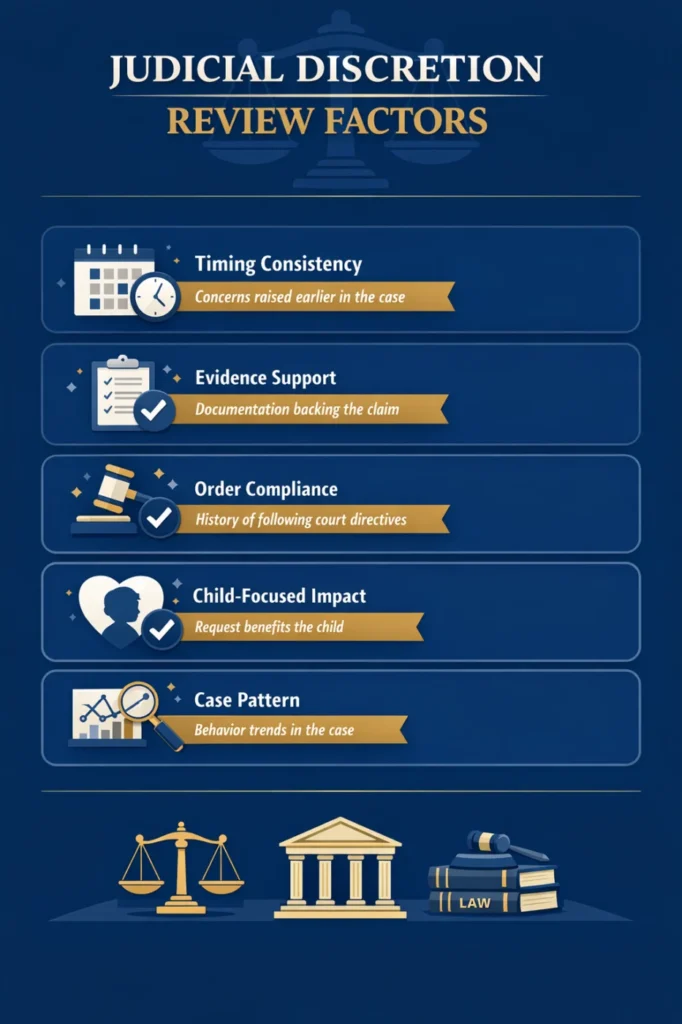
Source: North Carolina Best Interest Standard (Child Custody Law)
Judges often look at communication tone, compliance history, and willingness to cooperate. For example, repeated refusal to facilitate parenting time may be viewed differently than isolated scheduling disputes.
When evaluating credibility, courts also consider whether a party ignored mediation requirements or discovery deadlines. According to the North Carolina Judicial Branch, compliance with procedural rules is part of maintaining orderly proceedings. If you are evaluating strategic decisions before trial, you may speak with a family law attorney by visiting our Contact Us page.
What Strategic Mistakes Can Undermine Your Position Before Trial?
Late-stage errors often relate more to documentation and consistency than to the substance of a claim. Filing repetitive motions without new supporting facts, posting commentary about the case on social media, failing to update required financial affidavits, or ignoring prior warnings from the court can all affect how a judge evaluates reliability. North Carolina courts expect accurate and complete financial disclosures in equitable distribution matters under N.C. Gen. Stat. § 50-20.
Judges interpret these actions through the lens of credibility and child-focused judgment. While a single filing rarely determines the outcome of a case, repeated procedural missteps may influence how judicial discretion custody NC is exercised.
Courts also distinguish between good-faith litigation decisions and tactics that disrupt scheduled hearings, and the closer to trial a motion is filed, the more carefully it may be examined.
When Should You Seek Legal Review Before Making Late Decisions?
Trial preparation requires careful coordination of evidence, witness testimony, and legal standards. Consulting counsel before filing emergency requests or introducing new claims can help clarify whether the issue meets statutory thresholds.
In custody matters, late stage litigation choices custody NC parties make may be interpreted through broader case history. A lawyer can assess whether documentation supports the request and whether the timing strengthens or weakens credibility. Understanding how courts apply judicial discretion custody NC principles helps reduce avoidable risk before a hearing.
Know more about : Documenting Custody Exchanges: Using Police Reports to Prove Contempt in NC
How Late-Stage Decisions Shape Judicial Perception in North Carolina
Judges in North Carolina family courts examine timing, compliance, and consistency when assessing custody and divorce disputes near trial. Emergency filings, new allegations, financial inconsistencies, and order violations are evaluated carefully because they may reflect on credibility. Courts apply judicial discretion custody NC to weigh patterns rather than isolated incidents. Late decisions can influence how a judge interprets stability and cooperation.
If you are approaching trial and evaluating significant litigation decisions, contact North Carolina Divorce Attorneys at Martine Law at +1(704)-255-6992 to discuss your case.
FAQs About Late Stage Litigation Choices Custody NC
Do judges assume late filings are strategic?
No, judges do not automatically assume late filings are strategic. Courts review whether the issue arose recently and whether documentation supports urgency. Timing alone does not determine outcome, but late stage litigation choices custody NC judges evaluate must align with credible evidence and prior conduct. Consistency in raising concerns often carries weight during judicial review.
Can failing to comply with temporary custody orders affect trial outcomes?
Yes, a party’s non-compliance with temporary court orders, especially those concerning NC child custody, heavily influences a judge’s assessment of their reliability and credibility during trial. Repeated violations, which suggest a lack of respect for directives and unwillingness to prioritize the child’s best interests, negatively impact the application of judicial discretion.
Are emergency custody motions closely examined near trial?
North Carolina judges heavily scrutinize late-stage decisions in litigation, particularly emergency custody motions filed close to the trial date. The court demands specific proof of an immediate threat or harm, not merely a continuation of existing disputes. In their evaluation, judges will closely examine the submitted evidence, the timing of the motion, and whether standard scheduling procedures could have resolved the matter earlier.
Does changing legal strategy late in the case hurt credibility?
Yes, it can be relevant, depending on the circumstances. Judges often scrutinize whether a late shift in a party’s position is based on genuinely new facts or if it represents a contradiction of earlier stances. In particular, a sudden reversal in areas like settlement offers or proposed parenting arrangements may raise concerns about a party’s consistency, especially if the new proposal conflicts with prior communications.
Should I consult an attorney before making late litigation decisions?
To gain clarity on legal thresholds and evidentiary standards regarding late-stage litigation choices, it is advisable to consult legal counsel. If you have concerns about how your actions might be assessed under North Carolina judicial discretion custody standards, you can contact the North Carolina Divorce Attorneys at Martine Law by calling +1(704)-255-6992 to review your specific situation.
