

Quick Summary
Marital waste North Carolina refers to the dissipation or improper use of marital property by one spouse before or during separation in divorce proceedings. Courts examine financial behavior, transaction records, and the timing of spending to determine whether assets were used for marital purposes. When dissipation of assets NC divorce claim arises, judges may adjust equitable distribution to address financial losses affecting the marital estate.
Marital waste North Carolina occurs when a spouse improperly uses marital property in a way that reduces the value of the marital estate before property division. Courts examine financial activity to determine whether spending served legitimate marital purposes or resulted in the dissipation of assets NC divorce cases often address.
In divorce proceedings, evaluating financial conduct helps determine whether asset reductions should affect equitable distribution outcomes.
North Carolina Divorce Attorneys at Martine Law help individuals understand how courts review financial records and spending patterns to evaluate whether marital assets were misused or depleted during the marriage or after separation.
What Marital Waste Means In Divorce Proceedings
Marital waste refers to the misuse or unnecessary depletion of marital property by one spouse. Courts review financial conduct to determine whether the spending harmed the marital estate.
Dissipation typically occurs when assets are spent for purposes unrelated to the marriage or intentionally reduced before property division.
Common examples of potential dissipation include:
- Spending marital funds on non-marital relationships
- Selling marital property significantly below market value
- Excessive gambling or high-risk financial activity
- Large withdrawals without a clear household purpose
- Transferring marital funds to undisclosed accounts
These actions may affect how courts evaluate equitable distribution. Courts often review these issues alongside required financial disclosure to ensure transparency in the marital estate.
When Dissipation Of Assets May Be Considered
Dissipation claims arise when one spouse alleges that marital assets were intentionally reduced.
Courts evaluate the timing, purpose, and documentation of financial transactions, often relying on financial records as part of the divorce process, where financial activity and asset documentation may be reviewed during property disputes.
Spending is typically examined when it occurs close to separation or during pending divorce proceedings.
Financial Actions and Property Transfers Before Separation
Courts review financial transactions near the date of separation because unusual spending during this period may indicate attempts to reduce the value of the marital estate before property division.
Tracing Sudden Asset Transfers and Withdrawals
Large transfers or withdrawals may receive scrutiny because moving funds quickly can make marital assets harder to track or account for during divorce proceedings.
Unusual Purchases Inconsistent With Marital Finances
Purchases that differ significantly from a couple’s normal spending patterns may be examined because they could suggest funds were used for non-marital purposes.
Disposal Of Marital Property Without Consent
Selling or transferring shared property without the other spouse’s knowledge may raise concerns because the transaction could reduce the value of assets subject to division.
Financial Evidence Courts Review In Dissipation Claims
Courts rely on documented financial evidence to assess alleged asset dissipation. Detailed financial records help establish whether spending was legitimate or whether assets may have been used in ways that reduced the value of the marital estate.
Financial documentation allows judges to review transactions objectively and determine how assets were managed before and during divorce proceedings.
In many situations, disputes about financial conduct arise during a contested divorce, where both parties present financial records and explanations for transactions involving marital property.
Common forms of financial evidence include:
Evidence Type | Purpose In Court Review |
Bank statements | Identify withdrawals and transfers |
Credit card records | Track spending patterns |
Asset sale documents | Confirm the value received from property sales |
Financial account histories | Show the timing of transactions |
Business records | Verify financial transfers or distributions |
Financial documentation allows courts to analyze patterns and determine whether assets were used appropriately. These records help provide clarity when financial decisions become part of property and financial disputes during divorce proceedings.
Impact of Timing on Marital Asset Dissipation Evaluations
The timing of financial activity plays a significant role in marital waste evaluations. Courts assess whether spending occurred before or after the marital breakdown.
Transactions closer to separation often receive greater scrutiny because they may affect equitable distribution outcomes.
Key timing factors include:
- Spending during marital conflict
- Financial activity after separation
- Transfers made shortly before divorce filings
- Rapid liquidation of marital assets
When financial actions coincide with separation or divorce proceedings, courts may evaluate them more carefully.
Differences Between Waste And Legitimate Spending
Not every financial decision during marriage qualifies as marital waste. Courts distinguish between ordinary spending and transactions that improperly reduce marital property. Routine household expenses generally do not constitute dissipation because they support daily family needs.
Spending Type | Example | Why Courts May Consider It Legitimate |
Housing Expenses | Mortgage or rent payments | These costs maintain the marital home and support basic household stability. |
Household Utilities | Electricity, water, internet, and other services | Utility payments are part of normal living expenses required for the household. |
Child-Related Costs | Education, childcare, and healthcare | Expenses that support children’s well-being are generally viewed as an appropriate use of marital funds. |
Business Expenses | Operational costs for a family or spouse-owned business | Reasonable business spending may be necessary to maintain income or financial stability. |
When evaluating financial conduct, courts determine whether the spending supported marital responsibilities or reduced the value of marital assets without benefiting the household.
Know More: Fiduciary Duties: Why You Shouldn’t Empty Joint Accounts Before Separating in NC
Legal Remedies for Proven Dissipation of Assets
When courts determine that marital waste occurred, they may adjust property division outcomes. The objective is to restore fairness in the distribution of marital assets.
Judges evaluate financial conduct and may consider whether one spouse’s actions reduced the value of the marital estate. Judges may address dissipation through equitable distribution adjustments.
Possible court responses include:
- Assigning the dissipated value to the responsible spouse
- Offsetting asset distribution to compensate the other spouse
- Reclassifying financial transactions within the marital estate
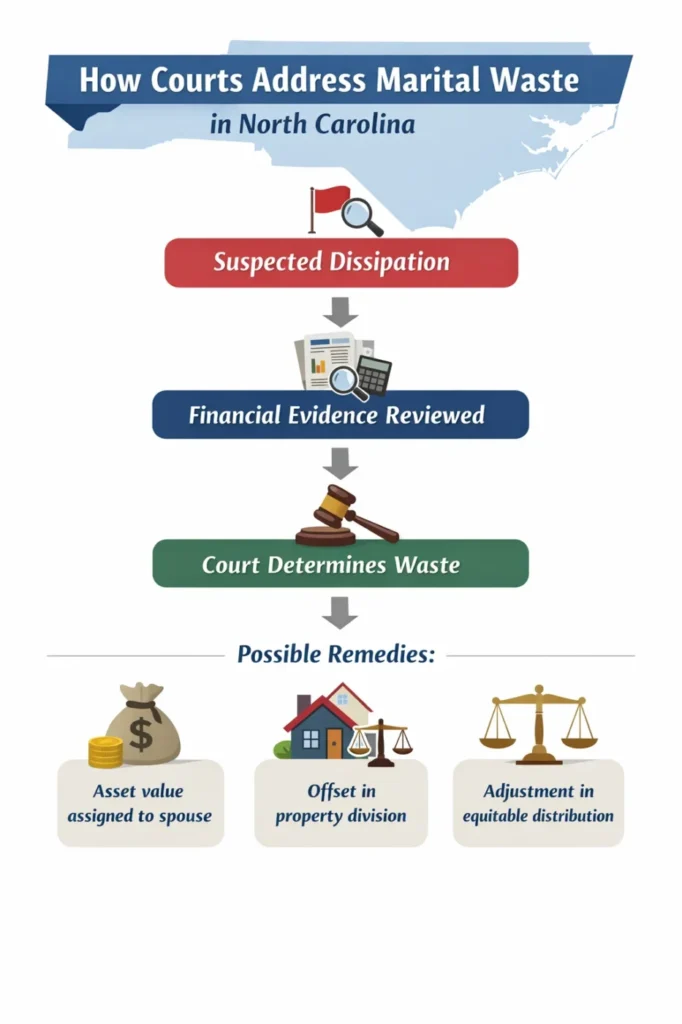
Source: North Carolina Judicial Branch – Equitable Distribution Overview
Financial documentation and court review help determine whether asset dissipation occurred and how property distribution should be adjusted. Courts rely on evidence and statutory guidelines when determining fair property allocation during divorce proceedings.
Relationship Between Hidden Assets And Marital Waste
Marital waste sometimes overlaps with attempts to conceal financial resources. Courts analyze financial transparency when evaluating whether assets were improperly used or hidden.
In some divorce disputes, allegations involve both dissipation and undisclosed financial holdings.
Situations where courts may review both issues include:
- Transfers to accounts not disclosed in financial filings
- Business income diverted before separation
- Assets placed under third-party control
- Incomplete financial disclosures
These issues may arise during broader investigations involving hidden assets, which can affect the classification and valuation of marital property during equitable distribution.
Financial Transparency And Asset Evaluation In Divorce
Divorce courts rely on clear financial documentation when evaluating property division disputes. Financial transparency allows judges to determine the true value of marital assets and review how financial decisions were made during the marriage.
Maintaining accurate financial records helps courts evaluate asset ownership, classification, and potential dissipation claims during divorce proceedings.
Types Of Financial Records Commonly Reviewed
Courts often examine several types of financial documents when evaluating marital property and potential dissipation claims.
Common financial records include:
- Bank statements and transaction histories
- Credit card account summaries
- Property ownership and title records
- Investment and retirement account statements
- Business financial reports and tax documentation
These records provide insight into financial activity and help courts establish the timing and purpose of financial transactions.
Why Financial Transparency Matters In Property Disputes
Financial transparency helps courts understand the full financial picture of the marriage. When both parties provide clear financial documentation, judges can evaluate property ownership, determine the value of assets, and review financial conduct leading up to separation.
Transparent financial reporting also helps courts distinguish between routine spending and financial activity that may raise concerns about dissipation of marital assets.
How Organized Financial Records Support Court Review
Well-maintained financial documentation allows courts to track financial patterns and identify irregular transactions. Records that clearly show the source, timing, and purpose of financial activity make it easier for judges to evaluate asset ownership and determine how property should be addressed during divorce proceedings.
Understanding the Financial Conduct In Property Division
Marital waste North Carolina cases involve careful examination of financial conduct, asset transfers, and the purpose of spending within a marriage. Courts analyze records, timing, and the impact of transactions to determine whether the dissipation of assets NC divorce claims affected the marital estate.
Because equitable distribution focuses on fairness rather than equal division, financial conduct during the marriage and around separation can influence how property is allocated. Accurate financial documentation and transparent asset disclosure help courts determine whether spending was legitimate or improperly reduced marital property.
Speak With Family Attorney About Property Issues
If you are navigating financial disputes during divorce, North Carolina Divorce Attorneys at Martine Law assist individuals with issues related to property division, financial transparency, and asset evaluation. You may call +1 (704) 255-6992 or visit the Contact Us page to discuss your situation.
FAQs
Can marital waste affect property division in a divorce?
Yes. Courts may consider marital waste in North Carolina when determining equitable distribution. If one spouse improperly depleted marital assets, the judge may assign the dissipated value to that spouse or adjust the final asset distribution. The purpose of this review is to maintain fairness when financial conduct reduced the value of the marital estate before property division.
Can ordinary spending during marriage be considered dissipation?
No. Routine household spending usually does not qualify as dissipation. Courts generally consider expenses for housing, utilities, healthcare, groceries, and child-related needs as legitimate uses of marital funds. Dissipation claims typically arise only when financial activity substantially reduces marital assets and does not serve a reasonable marital purpose or household responsibility.
Do courts require proof before recognizing asset dissipation?
Yes. Courts generally require credible documentation before recognizing asset dissipation. Evidence may include bank statements, financial records, transaction histories, or property sale documents showing that marital funds were used in a way that reduced the marital estate. Judges review both the timing and purpose of the transaction before determining whether dissipation affects property distribution.
Can financial behavior after separation still be reviewed?
Yes. Courts may review financial conduct that occurs after separation if it affects marital or divisible property. Transactions such as withdrawals from shared accounts, transfers of funds, or disposal of marital assets may be evaluated. These financial activities can be examined when courts determine how property should be distributed during divorce proceedings.
Can spending marital funds before separation be considered dissipation?
Yes. Courts may review financial activity that occurs shortly before separation to determine whether marital assets were intentionally reduced. Large withdrawals, unusual transfers, or rapid spending patterns may raise questions about whether one spouse attempted to reduce the marital estate. In some cases, courts examine these issues under dissipation penalties when evaluating how financial conduct affected property distribution.
