

Quick Summary
If you continue making payments on a mortgage or shared debt after separation, those payments may be reviewed during property division. In many post separation payments divorce NC situations, courts examine whether the payment reduced marital debt or preserved marital property. Understanding how these payments are evaluated helps you see how financial contributions made after separation may influence equitable distribution decisions.
After separation, one spouse may continue to pay shared expenses, such as the mortgage, loans, or other marital debts. In many post separation payments divorce NC situations, courts review these payments during property division to determine whether they preserved marital assets or reduced joint liabilities.
Judges often examine financial records, payment timing, and which spouse benefited from the expense when deciding whether a credit or adjustment may apply. Understanding how mortgage payments after separation NC are evaluated clarify how these contributions influence equitable distribution.
North Carolina Divorce Attorneys at Martine Law explain how courts review these payments within divorce process.
How Post-Separation Payments Affect Divorce Financial Reviews
In post separation payments divorce NC situations, courts review whether one spouse paid marital obligations after the separation date. These payments may affect how property and debts are evaluated during equitable distribution.
Courts typically review several factors when examining post-separation payments:
- Whether the payment was made with separate income
- Whether the obligation was a marital debt
- Whether the payment preserved marital property
- Whether the other spouse contributed to the obligation
When payments reduce marital debt or maintain marital assets, judges may consider whether a credit or adjustment should be applied during property division.
Types of Debts that Courts Often Evaluate
During divorce proceedings, courts may review various obligations incurred after separation. The goal is to determine whether the payment affected marital finances and whether it should be considered during property division.
Common debts reviewed in these situations include:
- Mortgage balances on marital homes
- Car loans obtained during marriage
- Credit card balances accumulated jointly
- Personal loans used for marital expenses
North Carolina courts apply equitable distribution principles when dividing marital assets and debts.
How Do Courts Determine Whether Credit Applies
Courts do not automatically reimburse every payment made after separation. Instead, judges review the financial impact of the payment and how it affected marital property or shared obligations.
To understand whether credit or reimbursement may apply, courts often examine several financial factors, including:
- Whether the payment reduced a marital obligation
- Whether the payment increased the value of marital property
- Whether the paying spouse used separate income
- Whether the other spouse received a financial benefit
Financial documentation, such as bank records, loan statements, and payment histories, often helps clarify these issues and show how the payment affected marital finances.
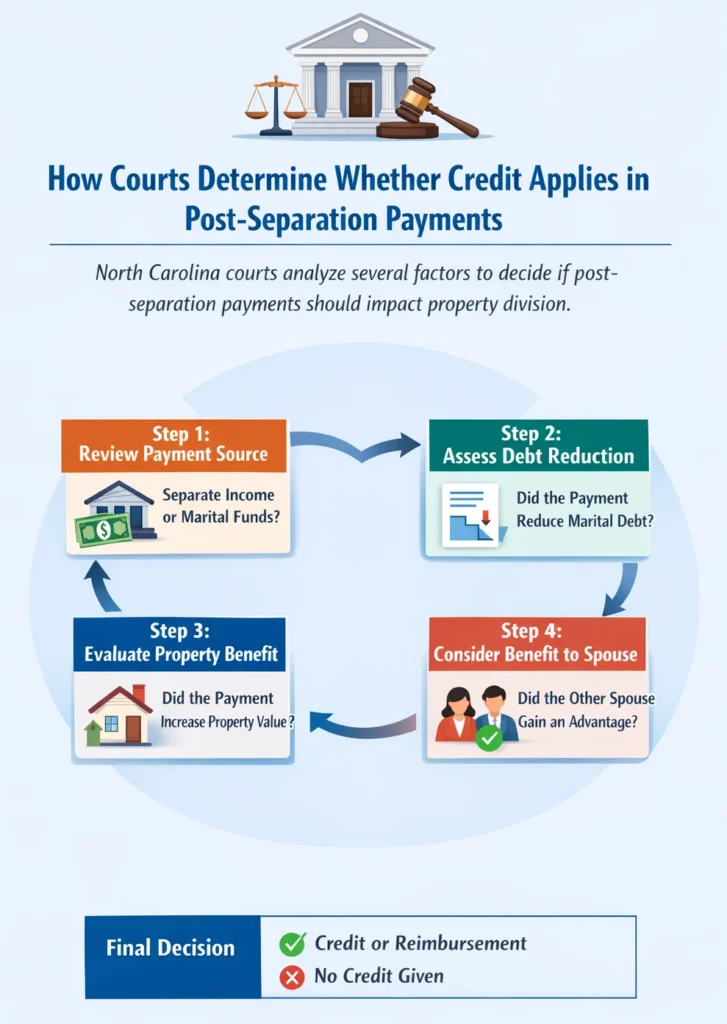
Source: North Carolina Judicial Branch – Divorce and Property Division Guidance
Understanding these factors helps explain how courts may interpret financial activity that occurs after spouses separate.
Documentation That Helps Prove Post-Separation Payments
Clear financial records often play an important role when courts review payments made after separation. Documentation helps demonstrate both the purpose of the payment and the source of the funds used.
When courts analyze post-separation payments, they often rely on records that show when the payment occurred and how it affected marital obligations. These records can help clarify whether a payment reduced shared debt or preserved marital property.
Useful documentation may include:
- Mortgage statements showing payment dates
- Bank account records showing the payment source
- Loan amortization schedules showing balance changes
- Property tax or insurance payment receipts
These records help courts determine whether a payment reduced a marital obligation or helped maintain a marital asset.
Record Type | What It Shows | Why It Matters |
Mortgage statements | Payment amounts and dates | Confirms when payments were made |
Bank records | Source of funds | Shows whether funds were separate or marital |
Loan statements | Remaining balance | Demonstrates how the debt changed |
Property expenses | Taxes or insurance | Shows ongoing maintenance of the property |
Reviewing this type of documentation helps courts understand how financial activity after separation may affect the evaluation of marital debts and property when courts apply equitable factors during property division.
In discussions related to stepparent custody rights NC, judges may examine the extent of the stepparent’s caregiving role and the consistency of that involvement over time.
When Reimbursement May Be Considered By Courts
Courts may consider reimbursement when post-separation payments significantly reduce marital debt or protect marital assets.
Situations where reimbursement may arise include:
- One spouse paid the entire mortgage after separation
- One spouse paid large joint credit card balances
- One spouse paid property taxes or insurance for a shared home
Judges examine whether those payments created an unequal financial burden between spouses. Courts may then adjust the distribution of property to account for the contribution, particularly when reviewing how marital debt should be allocated between spouses during divorce.
Know More: Marital Debt: When Liability Allocation Becomes the Main Battle in an NC Divorce
How Courts View Payments That Benefit One Spouse
Some payments after separation may benefit only one spouse rather than preserving marital property. Courts review the purpose of the payment before deciding whether it should affect financial issues that arise during an absolute divorce.
Examples may include:
- Paying living expenses in a home occupied by one spouse
- Paying debts tied only to one person’s personal expenses
- Maintaining assets used exclusively by one spouse
In these situations, courts may determine that the payment primarily benefited one party and may not adjust the distribution of marital assets.
Understanding Post-Separation Payments in North Carolina Divorce
Mortgage and debt payments made after separation can affect how courts review financial contributions during divorce. When one spouse continues paying shared obligations, judges may examine whether those payments reduced marital debt, preserved marital property, or benefited only one party.
Financial records, such as mortgage statements, bank statements, and loan histories, often help clarify how those payments affected the overall marital estate.
Understanding how post separation payments divorce NC situations are evaluated can help you see how courts analyze financial activity after spouses separate. Documentation and payment history may influence how marital debts and property are reviewed during equitable distribution proceedings.
Speak With North Carolina Divorce Attorneys
If you want to understand better how post-separation mortgage or debt payments may be evaluated in your situation, you may speak with North Carolina Divorce Attorneys at Martine Law. Connect at +1 (704) 255-6992 or visit our Contact Us page.
FAQs
Do post-separation payments automatically lead to reimbursement?
No. Courts review post separation payments divorce NC situations individually before deciding whether reimbursement applies. Judges examine whether the payment reduced marital debt, preserved marital property, or benefited both spouses. Financial documentation, payment timing, and the source of funds often influence how courts evaluate the payment when reviewing equitable distribution during divorce proceedings.
Can mortgage payments change how property is divided?
Yes. Continuing mortgage payments after separation NC may influence property division if those payments reduce the balance of a marital home loan or help preserve the property’s value. Courts often review whether the payment reduced shared debt and whether the paying spouse used separate funds when determining how financial contributions may affect equitable distribution.
What happens if both spouses continue paying marital debts?
When both spouses contribute toward shared obligations after separation, courts typically review the payment pattern. Judges compare financial records and contributions to determine whether the payments reduced marital debt or benefited both parties. Courts may also examine related financial activity, such as post-separation spending habits, when evaluating how marital assets and debts should be treated during equitable distribution.
How do courts determine whether a debt is marital?
Courts determine whether a debt is marital by reviewing when it was created and whether it benefited the household. Obligations incurred during the marriage for shared expenses, housing costs, or family needs are often classified as marital debt. Judges may examine financial records and the purpose of the obligation when evaluating debt during equitable distribution proceedings.
