

Quick Summary
In unequal property distribution NC divorce cases, courts apply equitable distribution principles to decide whether marital property should be divided unevenly. You may see unequal outcomes when judges review financial circumstances, contributions to the marriage, and future needs of each spouse. These decisions rely on statutory considerations known as equitable distribution factors NC, which guide how fairness is evaluated during property division proceedings.
An unequal property distribution NC divorce outcome occurs when a judge determines that dividing marital property equally would not be fair. North Carolina follows equitable distribution, meaning courts focus on fairness rather than a strict 50/50 split when dividing marital assets and debts.
In these cases, judges review several statutory considerations to decide whether an unequal distribution is appropriate. These considerations are commonly referred to as equitable distribution factors NC.
North Carolina Divorce Attorneys at Martine Law regularly explain how courts interpret these factors and how they influence property division decisions during divorce proceedings.
Equitable Distribution Principles In North Carolina Divorce Cases
North Carolina follows equitable distribution when dividing marital property in divorce. This means courts aim for fairness rather than automatic equality.
Judges begin with the assumption that equal division may be fair, but they may order an unequal outcome if statutory factors justify it. Property classification, valuation, and distribution all occur within this framework.
Key elements of equitable distribution include:
- Identifying marital, separate, and divisible property
- Determining the value of assets and debts
- Applying equitable distribution factors NC, which courts use to decide when an unequal division may be appropriate.
- Deciding whether an equal or unequal split is appropriate
The following visual outlines the typical steps courts follow when evaluating property division in a North Carolina divorce.
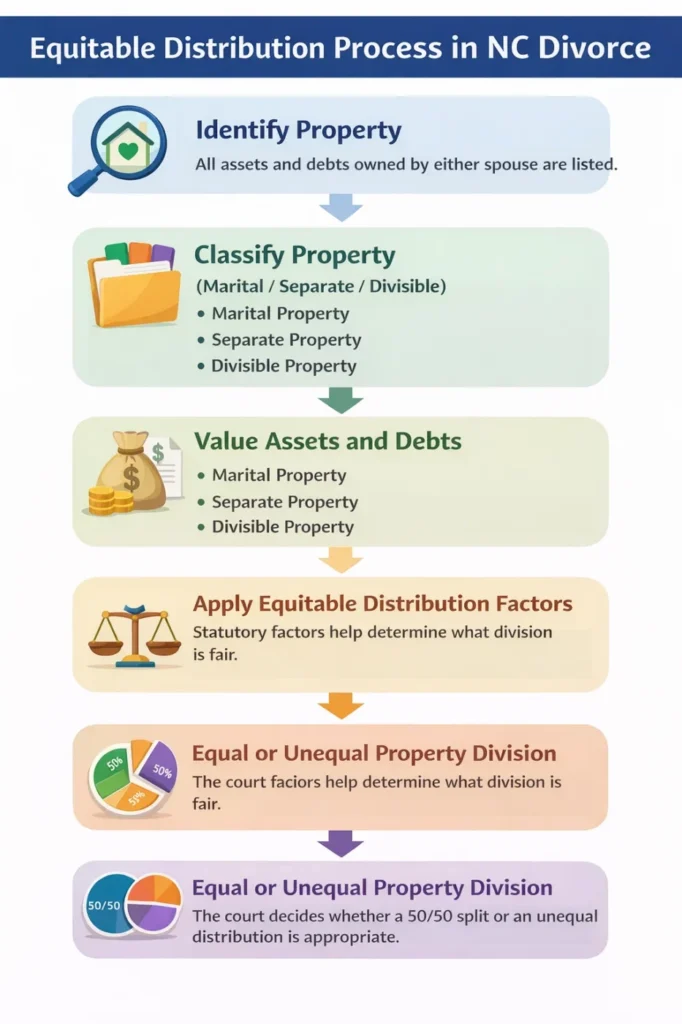
Source: North Carolina Equitable Distribution Statute
Courts focus on fairness based on each spouse’s financial and personal circumstances.
Situations Where Unequal Property Division May Occur
An unequal division may occur when the facts of the marriage indicate that equal division would not be equitable.
Judges evaluate financial records, marital contributions, and economic conditions to determine whether deviation from equal distribution is justified. These factors are often considered during property division in North Carolina divorce proceedings.
Common situations that may support unequal division include:
- Significant income differences between spouses
- One spouse assumes primary childcare or homemaking roles
- One spouse contributing to the other’s education or career
- Evidence of asset dissipation or financial misconduct
- Large differences in future financial needs
These situations help courts decide whether unequal property distribution NC divorce outcomes better reflects fairness.
Statutory Factors Judges Review During Property Distribution
North Carolina law provides statutory considerations that guide property distribution decisions. These equitable distribution factors NC help courts determine whether fairness supports an equal or unequal division of marital assets. Judges review financial conditions, personal circumstances, and contributions made during the marriage before making a final distribution decision.
Income and Property of Each Spouse
Courts review the income and financial resources available to both spouses. This may include wages, investment income, and property ownership that may affect financial stability after divorce.
Debts and Financial Obligations of Each Spouse
Judges examine outstanding debts and ongoing financial responsibilities. Credit balances, loans, and other obligations may influence how property and liabilities are divided.
Length and Duration of the Marriage
The duration of the marriage helps courts understand how long financial contributions were shared. Longer marriages often involve greater financial integration between spouses.
Age and Health of Both Spouses
A spouse’s age and health condition may affect earning ability and financial needs. Courts may consider whether one spouse requires additional financial support after divorce or whether related issues, such as spousal maintenance, may apply.
Contributions to Acquiring The Marital Property
Judges review how each spouse helped acquire or maintain marital assets. Contributions may include employment income, investment decisions, or managing household finances.
Contributions as Homemaker or Family Caregiver
Non-financial contributions also matter during property division. Managing the household or caring for children can be recognized as meaningful contributions to the marriage.
Tax Consequences of The Property Division
Courts may review potential tax consequences connected to asset transfers. Considering taxes helps ensure the final distribution remains fair and practical for both spouses.
Financial Circumstances Influencing The Unequal Distribution Decisions
Financial circumstances play a major role in determining whether property should be divided unequally.
Courts examine each spouse’s financial condition at the time of distribution and consider how property division will affect future stability.
Key financial considerations may include:
- Current income and earning capacity
- Existing assets and liabilities
- Future financial needs
- Access to employment or education opportunities
If the financial positions of spouses differ significantly, judges may find that unequal property distribution NC divorce outcomes better addresses long-term fairness.
Courts rely on accurate financial disclosures when evaluating income, assets, and liabilities during equitable distribution. If one spouse fails to disclose property or financial accounts, the court may review the issue during discovery and determine whether sanctions are appropriate.
Know More – Discovery Sanctions: What Happens When a Spouse Hides Assets During Equitable Distribution?
Marital Contributions and Household Responsibilities in Property Distribution
Courts evaluate both financial and non-financial contributions when dividing property. Your role in supporting the household, raising children, or managing family responsibilities may influence how marital assets are distributed.
Examples of contributions courts review include:
- Direct financial contributions to acquiring property
- Homemaking and childcare responsibilities
- Support provided to a spouse’s career development
- Contributions to increasing the value of property
These contributions are part of the equitable distribution factors NC used to evaluate fairness.
Asset Classification Before Unequal Property Distribution Decisions
Before deciding whether unequal distribution is appropriate, courts must first classify property. Property classification is separated by court into three legal categories that determine which assets are eligible for division and which remain with one spouse.
Property Type | Description |
Marital Property | Assets and debts acquired by either spouse during the marriage and before separation. These may include income earned during the marriage, real estate purchased together, retirement contributions, and other jointly acquired financial assets. |
Separate Property | Property owned by one spouse before the marriage or received individually through inheritance or gifts. These assets generally remain with the original owner unless they become mixed with marital assets. |
Divisible Property | Changes in value of marital property occurring after the separation date but before the court distributes the property. Examples include appreciation of investments, passive increases in asset value, or changes in marital debts. |
Only marital property and divisible property are subject to distribution decisions in a divorce case. Separate property typically remains with the spouse who originally owned it.
Accurate classification ensures that the unequal property distribution NC divorce analysis applies only to assets that the court has authority to divide. Equitable distribution cases require courts to first identify and classify property before determining its value and deciding how it should be divided between spouses.
Court Evaluation Of Evidence In Property Division Cases
Judges rely on documented evidence when deciding whether unequal distribution is appropriate.
Both spouses may present financial records, valuations, and testimony that explain their contributions and financial circumstances.
Evidence commonly reviewed includes:
- Income statements and tax returns
- Property appraisals and financial account records
- Business valuations
- Debt documentation
- Financial affidavits
These materials help courts apply equitable distribution factors NC objectively when evaluating property division.
Understanding Unequal Property Distribution Outcomes In Divorce
An unequal Property distribution NC divorce decision reflects the court’s effort to achieve fairness based on the circumstances of the marriage. Judges begin with the presumption that equal division may be fair, but they may adjust that outcome after reviewing statutory factors, financial conditions, and contributions from each spouse.
The equitable distribution factors NC guide how courts weigh income differences, household contributions, and future financial needs. These considerations help determine whether a greater share of marital property should be awarded to one spouse.
Property classification and valuation also influence the outcome because only marital and divisible property may be distributed between spouses.
Reaching Out To Family Law Attorneys
If you would like guidance on how property division rules may apply in your situation, North Carolina Divorce Attorneys at Martine Law can guide you. You may call +1 (704) 255-6992 or visit the Contact Us page.
FAQs
Is unequal property division allowed in North Carolina divorce cases?
Yes. Courts may order unequal property distribution NC divorce outcomes when an equal split would not be fair. Judges begin with the assumption that equal division may be reasonable, but they can adjust the distribution after reviewing financial conditions, marital contributions, and long-term economic needs. These considerations help courts determine whether a different distribution better reflects fairness.
What are the equitable distribution factors NC courts must consider?
Courts review equitable distribution factors NC to evaluate whether property should be divided equally or unequally. These statutory considerations may include financial resources, the length of the marriage, contributions made by each spouse, health conditions, and future financial needs. Evaluating these factors allows judges to determine whether the final distribution fairly reflects the financial circumstances of both spouses.
Does unequal property distribution mean one spouse did something wrong?
No. Unequal property distribution does not mean a spouse committed wrongdoing. Courts focus on fairness rather than blame when dividing marital property. Financial differences, caregiving responsibilities, or varying future financial needs may justify an unequal division even when both spouses acted appropriately during the marriage.
Can unequal property division apply to debts as well?
Yes. Courts may divide marital debts unequally when financial circumstances suggest a different allocation is fair. Debts incurred during the marriage, including loans or credit balances, may be assigned between spouses based on income, financial resources, and responsibility for the obligation. This approach ensures that assets and liabilities are distributed in a balanced way during divorce
